1

Tour Package

Hampi Tour Packages

City of Ruins

SUPER DEAL PRICE

STARTS FROM

per person on twin sharing
UNESCO World Heritage Site: Hampi
South India’s No.1 Travel Brand
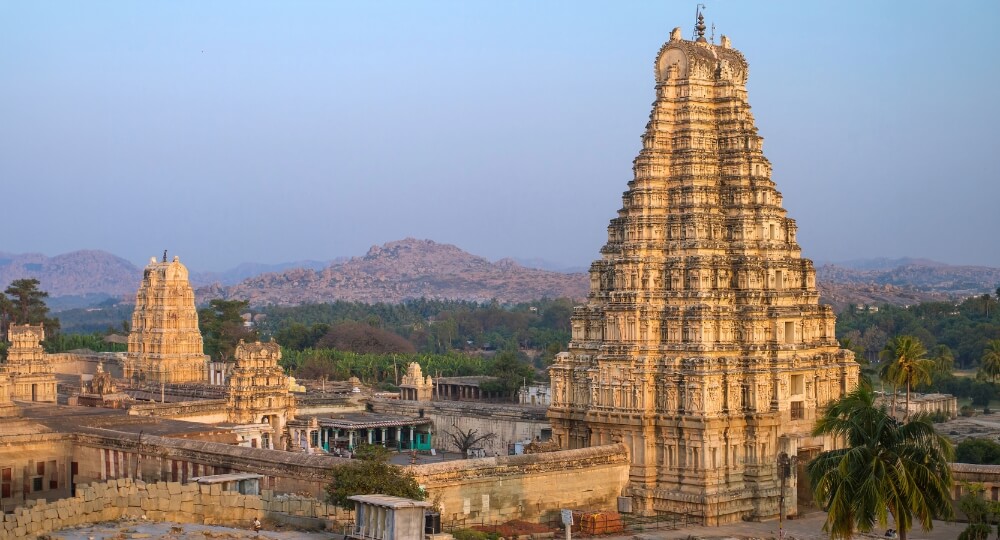
The Virupaksha Temple
Famous and Sacred Temple
Kannada, Hindi, English
Languages Speaking
Matanga Hill
Highest Point in Central Hampi
October - February
Best Time to Visit Hampi
Essential Tips for Travelling to Hampi

ATMs are easily accessible in main areas.

UPI and cash payments are widely accepted.

Banking facilities are available in Hampi.

The legal drinking age in Hampi is 21 years.

Residents are known for their warm hospitality.

Hampi - Overview

hampi tour map

By Purpose

tour package tourism

Couples

For Newlywed Vacations

tour packages business

Family

For Family Vacations

Top Attractions

Virupaksha Temple

Vittala Temple

Lotus Mahal

Elephant Stables

Queen’s Bath

Hemakuta Hill

Matanga Hill

Lakshmi Narasimha

Badavilinga Temple

Sasivekalu Ganesha

Kadalekalu Ganesha

Krishna Temple

Hazara Rama Temple

Achyutaraya Temple

King’s Balance

Everything You Need to Know About Hampi

Wander through a boulder-strewn landscape where temple gopurams rise above the Tungabhadra, abandoned bazaars stretch into the distance, and the ruins of a once-mighty empire settle quietly into the granite hills.

Hampi sits within a landscape that feels older than its monuments. Granite boulders rest on top of one another in impossible balances, the Tungabhadra River curves through the valley, and palm groves break the rocky horizon at intervals. Walking here, you start noticing the small things first. The way light catches a carved pillar at sunrise. The sound of slippers on stone in the Virupaksha Temple courtyard. The slow rhythm of a coracle drifting across the river. Hampi does not present itself all at once. It opens up slowly, ruin by ruin, hill by hill.

For Indian travellers, Hampi feels familiar in some ways and surprising in others. The temple architecture echoes traditions seen across South India. The market streets recall older trading towns. The pace stays unhurried, especially once you move away from the main bazaar. But the scale of what stands here, more than 1,600 recorded monuments spread across a vast site, sets Hampi apart. This was once the capital of the Vijayanagara Empire, a city that travellers from Persia and Portugal compared to the great cities of Europe. Hampi Tour Packages suit travellers drawn to history, open landscapes, and walks that lead from one quiet ruin to the next.

About Hampi

Hampi sits in the Vijayanagara district of east-central Karnataka, on the south bank of the Tungabhadra River. The setting is unlike anywhere else in South India. Massive granite boulders, some weighing many tonnes, lie scattered across the landscape as if dropped from above. Geologists trace this terrain to one of the oldest exposed rock formations in India, slowly weathered over millions of years into the rounded shapes seen today. The boulders form natural walls, viewpoints, and shelters, and the builders of Vijayanagara incorporated them directly into their fortifications, temples, and royal complexes.

The Tungabhadra River, also referred to as the Pampa River, is sacred to Hindu pilgrims. It shapes the northern edge of the site. Its course has long supported settlement here, providing water for the city and irrigation for surrounding fields. The river is usually wide and slow here, though its flow strengthens during the monsoon. It’s broken in places by rocks where coracle boatmen cross to the villages on the opposite bank. Banana groves, sugarcane fields, and paddy plots stretch inland from the river, creating sudden patches of green against the otherwise dry, rocky terrain.

The land around Hampi alternates between low hills and open plateaus. Hemakuta Hill rises gently at the centre, dotted with small early temples. Matanga Hill rises to the east, offering one of the most expansive views of the ruins. Anjanadri Hill, across the river in Anegundi, rises sharply and is associated in Hindu tradition with Hanuman’s birthplace.

Vegetation stays sparse on the rocky stretches but turns lush near the river and in the cultivated areas. Tamarind trees, neem, and acacia provide intermittent shade. Local wildlife includes peacocks, langurs, and a small population of sloth bears in the nearby Daroji Bear Sanctuary.

Hampi experiences a hot, semi-arid climate. Summers are intense, with temperatures often crossing 38°C between April and June. Winters are mild and dry, with cool mornings and warm afternoons, making this the most comfortable season to visit. The monsoon, from July to September, brings short, often heavy showers, leaving the surrounding fields and the river itself looking fuller and greener.

Hampi’s geography influenced every aspect of the city’s construction. Defensive walls were laid on top of natural ridges. Temples used boulders as natural shrines or backdrops. Stepwells and large stone tanks captured water from the river and from the monsoon runoff. Even today, the ruins do not feel separate from the land. They feel built into it.

History & Heritage

Hampi’s story begins long before the Vijayanagara Empire. The area is traditionally associated with the Ramayana as Kishkindha, the kingdom of the monkey king Sugriva, and is considered a deeply sacred site in Hindu tradition. Temples and shrines existed here from at least the 7th century, with the Virupaksha Temple tracing its origins to that early period. The wider region fell within the Mauryan empire, with Ashokan edicts found in parts of the present-day Ballari district.

The defining chapter began in 1336 CE, when the brothers Harihara I and Bukka Raya founded the Vijayanagara Empire, choosing this rocky and easily defensible site on the Tungabhadra as their capital. Over the next two centuries, four dynasties ruled from here in succession: the Sangama, Saluva, Tuluva, and Aravidu. Under their patronage, Vijayanagara grew into one of the largest and wealthiest cities in the world with a population of several hundred thousand and a thriving trade in cotton, spices, gemstones, and horses.

The empire reached its peak under Krishnadevaraya, who ruled from 1509 to 1529. He expanded the kingdom across most of southern India, commissioned major temples, and welcomed scholars, poets, and traders to his court. Persian and Portuguese chroniclers, including Domingo Paes, Fernão Nunes, and Abdur Razzaq, described Vijayanagara in detail. They wrote of broad bazaars, large public squares, royal processions with elephants. They compared it to Rome for its scale and splendour.

The decline came suddenly. In 1565, the combined armies of the Deccan Sultanates of Bijapur, Ahmadnagar, Golconda, and Bidar defeated the Vijayanagara forces at the Battle of Talikota. The city was then looted and burned. What survived the destruction was largely abandoned. The capital shifted south to Penukonda, and the great urban centre that had stood here was left to the jungle and the wind.

For nearly three centuries, Hampi remained a quiet ruin known mainly to local communities and pilgrims who continued worship at the Virupaksha Temple. In the 19th century, British officers and surveyors, including Colonel Colin Mackenzie and later Alexander Rea, began documenting the site. The historian Robert Sewell’s 1900 book A Forgotten Empire brought Hampi to global academic attention. The Archaeological Survey of India has since carried out extensive conservation, and in 1986, the Group of Monuments at Hampi was inscribed on the UNESCO World Heritage List.

Today, Hampi’s history is not locked away in museums. It continues openly, in the lanes around the Virupaksha Temple where worship has carried on uninterrupted for centuries, in the bazaar streets that still bear the layout of the old market quarters, and in the villages of Anegundi and Kamalapura where families have lived for generations alongside the ruins. History buffs can request a special tour guide specialising in Vijayanagara history for an in-depth experience of the ruins when booking your Hampi tour packages.

Geography

The districts of Sivagangai and Pudukottai are semi-arid with high temperatures and very low rainfall. While April and May are the hottest months of the year, temperatures are consistently above 30 °C.

Economy

While agriculture isn’t huge, the regions in and around Pudukottai are known for groundnut cultivation, along with millets, cotton, and pulses, thanks to the irrigation provided by the Grand Anaikat Canal. As for Sivaganga, the region is known for its cultivation of sugarcane, groundnut, pulses, chillies, coconut, and sesame.

Tourism is a growing industry, driven by increased interest in heritage tours. Many erstwhile palatial homes, such as The Bangala and Visalam, have been converted into heritage hotels that offer a comprehensive Chettinad experience to guests.

How to Reach Hampi

Hampi sits in a relatively remote part of inland Karnataka, and reaching it usually involves combining two modes of travel. The town itself has no airport and no railway station, so visitors typically pass through the nearby town of Hosapete (formerly spelt Hospet), about 13 km away, which serves as the main transport gateway.

By Air

The nearest small airport is Jindal Vijayanagar Airport at Toranagallu, also known as Vidyanagar Airport, about 35 to 40 km from Hampi. It handles limited flights, primarily from Bengaluru and Hyderabad, and schedules can change seasonally.

The nearest major commercial airport is Hubballi (Hubli) Airport, about 150-170 km from Hampi, with regular flights from Bengaluru, Mumbai, Hyderabad, and a few other cities. The drive from Hubballi to Hampi takes about 4 hours.

The most reliable air gateway remains Bengaluru’s Kempegowda International Airport, about 350 km away, with international and domestic connections from across India and abroad. From Bengaluru, you can either take a connecting train, an overnight bus, or hire a taxi. A direct road journey takes 7 to 8 hours.

By Train

Hosapete Junction (HPT) is the nearest railway station, about 13 km from Hampi. It is connected with Bengaluru, Hubballi, Hyderabad, Mysuru, Goa, Vijayawada, Tirupati, and several other cities. The most popular service for visitors from Karnataka is the overnight Hampi Express between Mysuru and Hosapete via Bengaluru. From Hosapete Junction, you can hire an auto-rickshaw or take a local bus to Hampi.

By Road

Hampi is well connected by road to the major cities of Karnataka and to neighbouring states.

From Bengaluru: about 350 km, roughly 7 to 8 hours via NH 48 and NH 50 through Chitradurga and Hosapete. From Hubballi: about 150 km, roughly 3.5 to 4 hours. From Hyderabad: about 380 km, roughly 8 to 9 hours. From Goa (Panaji): about 330 km, roughly 7 to 8 hours.

State-run KSRTC buses and private operators run regular overnight services from Bengaluru, Hyderabad, and Goa to Hosapete. Private taxis are the most comfortable option for families travelling. Once in Hampi, distances between sites are short, but the terrain is rocky and exposed. Auto-rickshaws, hired bicycles, and mopeds remain the most common ways to move around.

Best Time to Travel

October to February offers the most pleasant weather and is considered the ideal time to book Hampi tour packages. March to June brings intense heat that can make midday sightseeing tiring. July to September sees occasional rain, leaving the surroundings green and the river full, though some boulder paths can become slippery.

Tidbits About Hampi

Category Details
Location Vijayanagara district, east-central Karnataka, on the south bank of the Tungabhadra River
Elevation ~470 metres above sea level
Official Languages Kannada, English understood in tourist areas, Hindi widely spoken
Famous For Group of Monuments at Hampi (UNESCO World Heritage Site), Virupaksha Temple, Vittala Temple stone chariot, boulder-strewn landscape, and ruins of the Vijayanagara Empire
Best Time to Visit Oct–Feb: for cool, comfortable weather and easy sightseeing.
Mar–Jun: extremely hot; limited midday outdoor movement.
Jul–Sep: occasional rain; lush green surroundings; fewer crowds.
Ideal Duration 2 to 3 nights
Nearest Major Town Hosapete (Hospet) ~13 km, ~30 min by road
Nearest Major City Bengaluru ~350 km by road, 7 to 8 hours via NH 48 and NH 50

Travel Requirements

Carry a valid government photo ID such as an Aadhaar card, driver’s licence, or passport. ID is required at hotel check-ins and at the entry counters of the ticketed monuments, such as the Vittala Temple complex and the Zenana Enclosure.

International travellers must hold a valid Indian visa. Keep both digital and physical copies of passport and visa details. Foreign nationals pay a higher entry fee at ticketed monuments and may be asked to show their passport at entry counters.

Digital payments such as UPI and cards are accepted at most hotels, larger restaurants, and resorts. Carry cash for auto-rickshaws, coracle crossings, small eateries, market purchases, monument entry tickets, and tips for guides.

Hampi has no metro system or app-based ride-hailing services. Local travel depends on auto-rickshaws, mopeds, bicycles, and private taxis hired through hotels or local stands. Pre-book vehicles for full-day sightseeing.

Wear lightweight cotton clothing during the day. The site is largely exposed with little shade between monuments. Carry a hat, sunglasses, and a refillable water bottle. A light shawl helps on winter mornings and evenings.

During the summer months from March to June, daytime heat can climb above 38°C. Plan outdoor sightseeing for early mornings or late afternoons, and rest indoors during midday.

Drink bottled or filtered water. Avoid untreated tap water.

Wear sturdy walking shoes. Many sites involve uneven granite paths, steps, or short scrambles. Sandals are suitable for the Virupaksha Temple courtyard but not ideal for Matanga Hill or Hemakuta Hill.

Respect local customs at temples. Remove footwear before entering sanctums, dress modestly with shoulders and knees covered, and seek permission before photographing people in markets or villages.

The area north of the Tungabhadra River, often called Virupapur Gaddi or Hippie Island, is reached by coracle and has its own pace. Carry cash, as ATMs across the river are limited.

Avoid littering at the monuments. Hampi is a protected UNESCO World Heritage Site, and the Archaeological Survey of India enforces conservation rules across the property.

Top 6 Reasons to Choose Hampi Tour Packages

History

The group of monuments at Hampi spreads across a wide protected area, but the most significant temples, palaces, and bazaars cluster within a manageable area. Travellers can explore the Sacred Centre, the Royal Centre, and the riverside ruins across two to four days without long road journeys, which suits families and first-time visitors.

Landscape

A landscape unlike any other in India, the boulder-strewn terrain around Hampi is a geological wonder in its own right. Granite formations, river bends, and palm groves combine to create a setting that feels surreal even before you reach the first temple. Photographers, hikers, and nature lovers find Hampi rewarding regardless of how much history they choose to absorb.

Heritage

Unlike many ancient sites, Hampi is not a closed museum. The Virupaksha Temple has a long, continuous tradition of worship. Villages such as Anegundi and Kamalapura still surround the ruins. Markets near the temple, ferry crossings on the river, and small chai stalls give the site a lived-in quality that connects past and present.

Relaxed Pace

Suited to slow, walking-paced travel, Hampi rewards travellers who slow down. Most monuments are best seen on foot, by bicycle, or by short auto rides between spots. There are no long highway transfers within the site, no rushed convoys, and no fixed performance schedules. Days here can be shaped around sunrise viewpoints, mid-morning temple visits, lazy afternoons by the river, and sunset walks on the hills.

Architecture

Hampi provides a strong introduction to South Indian temple architecture. The Vijayanagara style at Hampi represents the culmination of centuries of Dravidian temple-building tradition. Visitors can see fully evolved gopurams, intricately carved mandapas, kalyana mandapas, chariot-shaped shrines, and even Indo-Islamic-influenced secular buildings such as the Lotus Mahal and the Elephant Stables. Hampi serves as a foundation for understanding later visits to Pattadakal, Badami, Belur, Halebid, and the great temple cities of Tamil Nadu.

A natural pairing with other Karnataka destinations, Hampi can be combined with Badami, Pattadakal, and Aihole for a Chalukyan circuit, with Hubballi and Dharwad for a regional route, with Goa for a contrasting beach extension, or with Bengaluru and Mysuru for a broader Karnataka itinerary. The road and rail links make extensions practical without long backtracking.

Best Places to Visit With Our Hampi Tour Packages

Virupaksha Temple

The Virupaksha Temple is the heart of Hampi and one of the oldest active temples in the region, with a long, continuing tradition of worship. It is dedicated to Virupaksha, a form of Shiva, and his consort Pampadevi, the goddess associated with the region. The towering eastern gopuram rises about 50 metres and dominates the skyline of Hampi Bazaar. Inside, pillared halls, smaller shrines, and ceiling paintings illustrating Hindu mythology fill the courtyard. Annual festivals, including the spring chariot festival and Maha Shivaratri, draw large crowds. Early mornings here feel calm and reflective, with priests preparing the day’s rituals and pilgrims completing quiet circumambulations.

Vittala Temple and the Stone Chariot

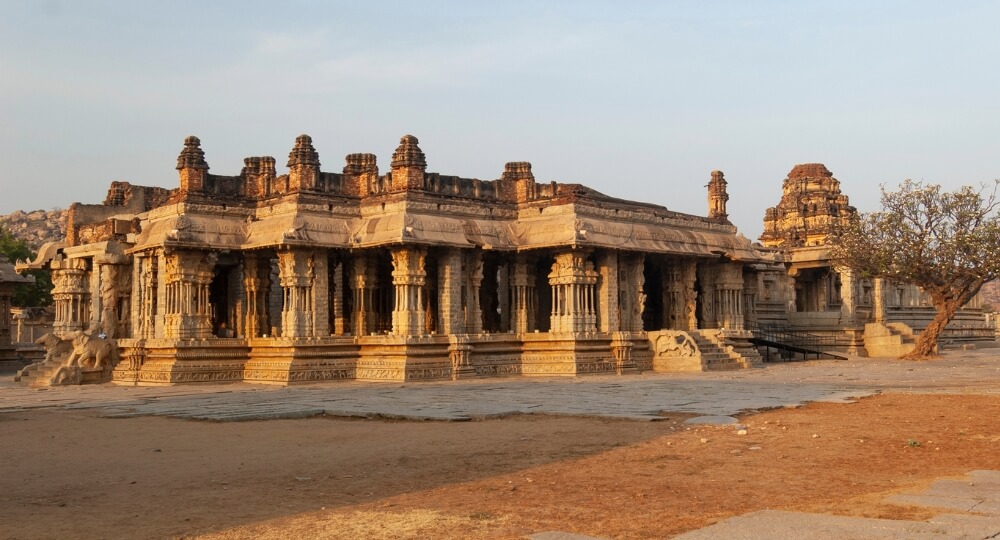
The Vittala Temple, located near the Tungabhadra River about three kilometres east of the Virupaksha Temple, is widely considered the architectural high point of the Vijayanagara style. Most scholars date the main construction to the early-to-mid 16th century, with successive kings adding to the complex. The temple is dedicated to Vitthala, a form of Vishnu.

At its centre stands the famous Stone Chariot, a granite shrine to Garuda fashioned as a temple car. Although it looks monolithic, the chariot is built from large blocks fitted so precisely that the joints almost vanish. Its image appears on the Indian fifty-rupee currency note. The temple’s main hall is also famous for its musical pillars, slender granite columns that produce distinct tones when tapped, (now protected and not to be touched) and for the surrounding kalyana mandapa, the long bazaar street, and the stepped temple tank.

Hemakuta Hill

Hemakuta Hill rises just south of the Virupaksha Temple and features a cluster of small early temples and shrines, many of which predate the Vijayanagara Empire. The hill is gentle to climb and offers a sweeping view over the temple complex, the river, and the surrounding boulder fields. Sunrise and sunset are popular here, with the light catching the granite surfaces and softening the contours of the ruins below.

Matanga Hill

Matanga Hill is one of the highest point in central Hampi and offers the most expansive view over the entire site. The climb takes about 20 to 30 minutes and involves a steady ascent over uneven granite. Travellers often head up before dawn to watch the sun rise over the river and the ruins. The view from the top stretches across the Sacred Centre, the Royal Centre, and the river bend, giving you the full sense of how the city once spread across this landscape.

Lotus Mahal and Zenana Enclosure

The Zenana Enclosure is a walled area within the Royal Centre believed to have been reserved for the women of the royal household. The exact function of the enclosure remains debated among historians.

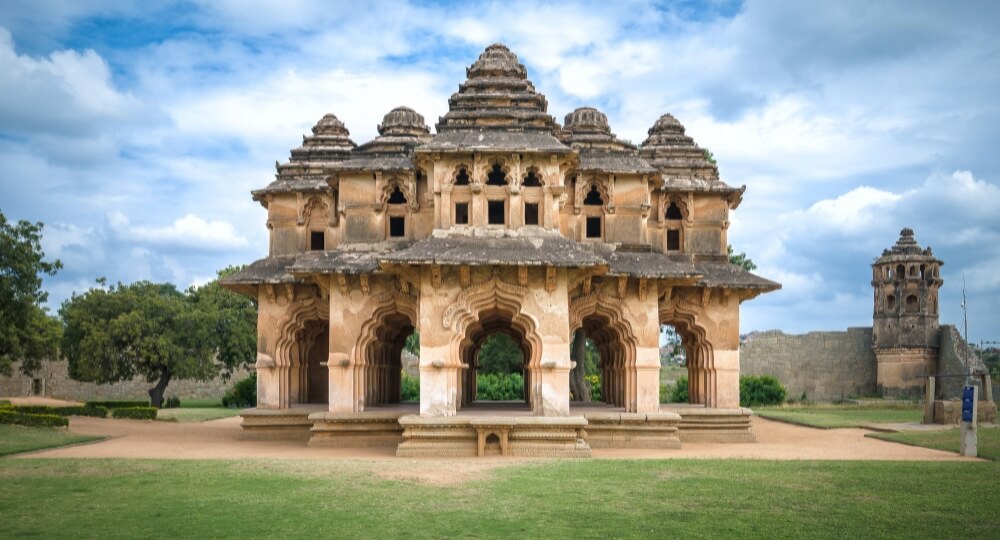
The most striking structure inside is the Lotus Mahal, a two-storey pavilion shaped to resemble a half-open lotus. Its arches, plastered surfaces, and pyramidal towers reflect a graceful blend of Hindu and Islamic architectural traditions, marking it as one of the finest examples of Vijayanagara secular architecture.

Elephant Stables

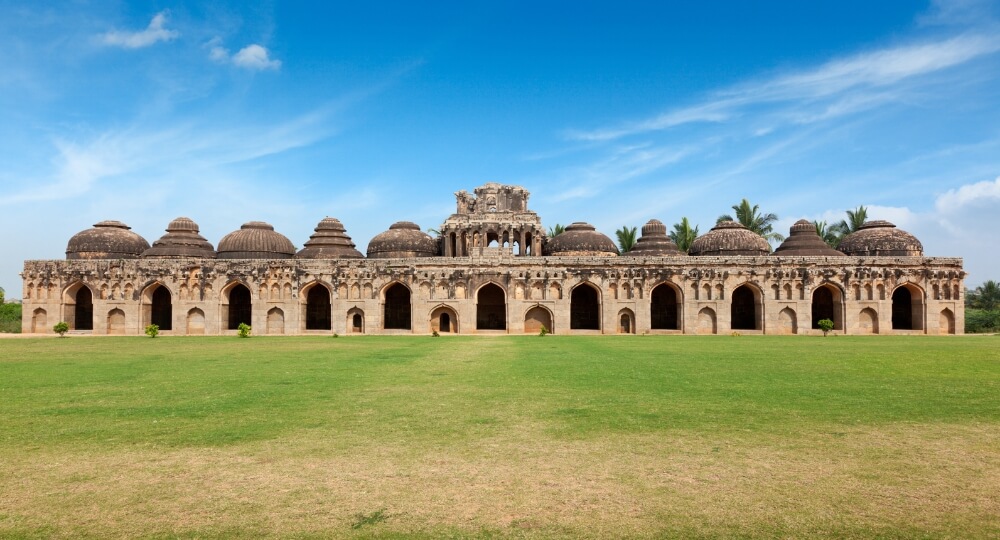
Just outside the Zenana Enclosure stands the Elephant Stables, an elongated rectangular building with eleven domed and vaulted chambers arranged symmetrically along a raised central pavilion. Each chamber once housed ceremonial elephants belonging to the royal household, with iron fittings still visible on some ceilings. The mix of dome shapes and the central tower give the structure an unusual rhythm, and it remains one of the best-preserved monuments in the Royal Centre.

Royal Enclosure and Mahanavami Dibba

The Royal Enclosure, in the heart of the Royal Centre, holds the foundations of palaces, audience halls, and ceremonial spaces of the Vijayanagara kings. At its centre is the Mahanavami Dibba, a large stone platform built by Krishnadevaraya and used during the Mahanavami (Dussehra) festival to host royal processions and performances. The platform is decorated with carved registers showing courtly life, military scenes, and animals. Nearby stand the stepped tank, the underground Shiva temple, and the remains of the great audience hall.

Hazara Rama Temple

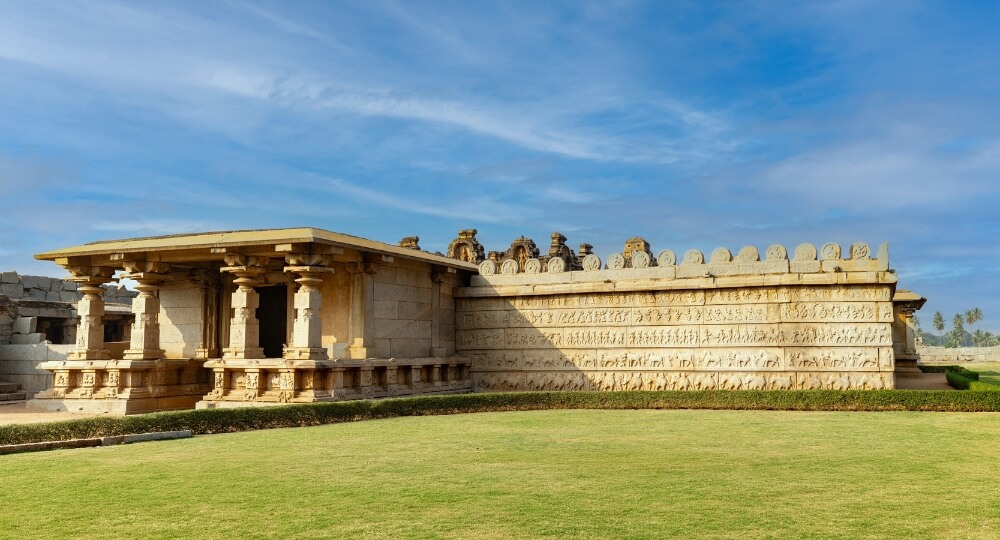
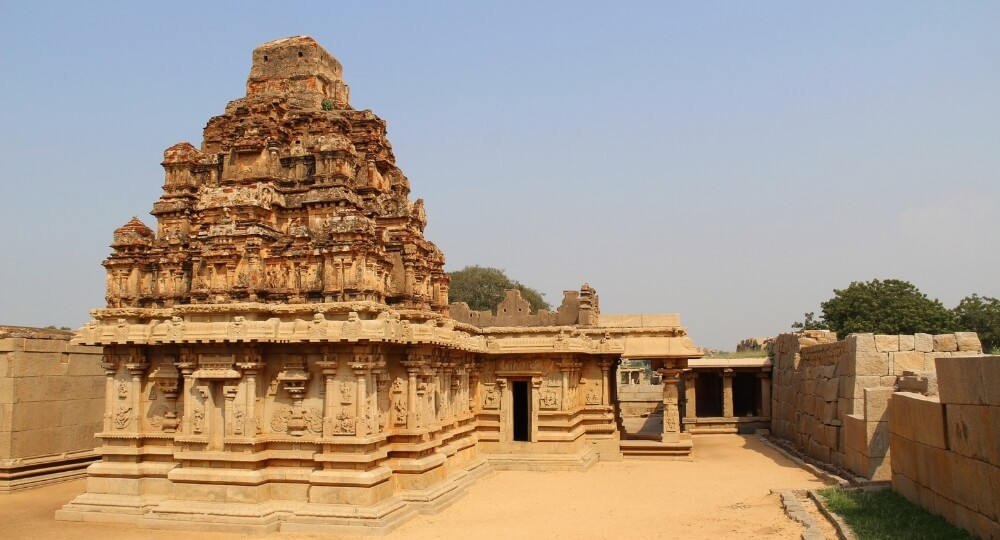
Hazara Rama Temple sits within the Royal Centre and was likely the private chapel of the Vijayanagara kings. Its compact size belies its decorative richness. The outer walls are carved with bands of friezes depicting episodes from the Ramayana, while inner pillars of polished black stone show further mythological scenes. The temple is one of the best places in Hampi to study Vijayanagara narrative art up close.

Queen's Bath

The Queen’s Bath, near the Royal Centre, is a square structure with a plain exterior that conceals an ornate interior arranged around a central pool. Lobed arches, balconies projecting over the water, and stuccoed domes give the room a clearly Indo-Islamic flavour. It is traditionally associated with the women of the royal household, although it may have been used more broadly by the court.

Lakshmi Narasimha and Badavilinga

Just south of the Sacred Centre stand two of Hampi’s most arresting monolithic sculptures. The Lakshmi Narasimha statue, carved from a single boulder, depicts the man-lion form of Vishnu seated on the coils of the serpent Sesha. The figure is large and powerful, though damaged in places; it originally included Lakshmi seated on Narasimha’s lap, a portion that is no longer visible. Right beside it stands the Badavilinga, a tall granite linga that rises from a small chamber filled with water at its base, an arrangement that gives the shrine a quietly meditative quality.

Other Places to Explore

Anegundi

Anegundi is an ancient village across the Tungabhadra from Hampi, considered one of the older settled areas in the region, with a history that predates the Vijayanagara capital. It contains its own ruins, traditional houses, and active temples. The surrounding countryside is gentle and rural with banana plantations and small fields. Coracle crossings from the Hampi side, when operating, make the journey part of the experience.

Anjanadri Hill

Anjanadri Hill rises sharply across the river and is associated in local tradition with the birthplace of Hanuman. The climb involves about 575 steps and ends at a small temple at the summit. The view stretches across the boulder fields, river bend, and the ruins of Hampi on the far side.

Sanapur Lake

Sanapur Lake is a calm reservoir set among boulders not far from Anegundi. It is a popular spot for short walks, photography, and quiet stops between sightseeing days. Coracle rides are sometimes available through local operators.

Tungabhadra Dam

The Tungabhadra Dam, near Hosapete, is a multipurpose reservoir built across the Tungabhadra River. It supports irrigation, drinking water supply, and hydroelectric power for the region. The gardens around the dam are popular for evening visits, especially when the fountains are active.

Daroji Sloth Bear Sanctuary

The Daroji Sanctuary is set within a dry, rocky landscape and is one of the few places in India where sloth bears can be observed in the wild. Late afternoon visits are best, when bears come out to feed and can sometimes be seen from the watchtower.

Kamalapura

Kamalapura is a small town close to the Royal Centre and home to the Archaeological Museum, which holds sculptures, coins, weapons, and a scale model of the original Vijayanagara city. The museum offers a good orientation either at the start or end of a Hampi visit.

Badami, Pattadakal, and Aihole

This Chalukyan circuit lies further west and forms a natural extension to a Hampi trip for travellers interested in earlier South Indian temple architecture. Badami is known for its rock-cut cave temples, Pattadakal for its UNESCO-listed group of temples, and Aihole for its early experimental shrines.

Gandikota

Often called the Grand Canyon of India, Gandikota lies further east in Andhra Pradesh and is sometimes combined with longer Karnataka–Andhra circuits. The river gorge, fort, and surrounding rocky terrain make for a striking detour.

Shopping in Hampi

Shopping in Hampi is small-scale but distinctive. The markets here do not match the size of Jaipur or Jodhpur, but the items reflect the heritage of the surrounding region: stone craft echoing the Vijayanagara legacy, vivid Lambani embroidery from the nomadic communities of the Ballari district, banana-fibre crafts from the local plantations, and the kind of light cotton clothing favoured by long-stay travellers. Bargaining is part of the experience, but stays gentle, especially with the smaller artisan-run shops.

What to Buy

Lambani Embroidery

The Lambani (also called Banjara) communities of the Ballari district are renowned for a vivid embroidery tradition that combines mirror work, cross-stitch, pattern darning, beading, cowrie-shell trims, and patchwork on a coloured cotton or khadi base. The Lambani embroidery of the Sandur region received a Geographical Indication (GI) tag in 2010, recognising its distinct identity. Look for embroidered bags, belts, jackets, cushion covers, wall hangings, and small accessories. Initiatives such as the Sandur Kushala Kala Kendra work directly with Lambani women artisans, offering more reliable quality and fairer prices than informal bargaining.

Banana Fibre Crafts

Banana plantations cover much of the land around Hampi, and local artisans extract the fibre from the stems to produce bags, baskets, table mats, pen stands, cushion covers, and small home accessories. The work is eco-friendly, durable, and increasingly popular among travellers seeking sustainable souvenirs. They are available from small vendors and cooperative outlets and may not be widely available across all stalls.

Stone Carvings and Replicas

Local craftsmen produce small carved stone pieces, including miniature representations of the Stone Chariot, deities, animals, and decorative panels. These are usually crafted from softer stone rather than the granite of the original monuments, which makes them lighter to carry home. Most miniatures are produced in regional craft centres.

Antique-Style Coins and Brass Items

Replicas of Vijayanagara-era coins and small brass artefacts are sold across the bazaar. These are crafted imitations rather than antiques and make light, easily portable souvenirs. Items sold as “old coins” are almost always replicas. Genuine antiquities are subject to strict export laws and should not be bought from informal vendors.

Jewellery and Tribal Accessories

Oxidised silver jewellery, tribal-style necklaces, anklets, rings, and semi-precious stone pieces are widely sold across Hampi’s markets. Many designs draw loosely from traditional Indian and nomadic styles, though most are produced in regional workshops rather than locally handcrafted. Quality varies, so check clasps, stone settings, and metal finish before buying.

Cotton Clothing and Bohemian Wear

The long-running backpacker scene has shaped a market for loose cotton kurtas, harem pants, skirts, scarves, and tie-dye tops at very modest prices. These are practical for the warm climate and have become popular as casual summer wear back home.

Leather Goods

Bags, sandals, belts, and wallets made from leather are widely available but are not specific to Hampi or the region. Quality varies, so it is worth checking the finishing and stitching before buying.

Books and Travel Reads

Small stalls and cafés, especially around Virupapur Gaddi, often stock second-hand books, travel literature, and spiritual reads. These are typically left behind or exchanged by travellers, creating an informal, rotating collection rather than a curated bookstore. Condition varies, but prices are modest, and browsing can be part of the experience.

Where to Buy

Hampi Bazaar (Virupaksha Bazaar)

The main shopping street runs east from the Virupaksha Temple along a kilometre-long stretch lined historically with two-storeyed pavilions. Today, it remains the central market for travellers, with stalls selling textiles, jewellery, small souvenirs, snacks, and travel essentials. The bazaar is busiest in the morning and again toward sunset, when light catches the temple gopuram at the western end.

Virupapur Gaddi (Hippie Island)

Across the river from Hampi, this area has its own cluster of small shops, cafés, and informal markets aimed at the long-stay traveller crowd. Cotton clothing, books, jewellery, and casual accessories dominate. Establishments are subject to periodic closures and rebuilding, with the number of shops and cafés fluctuating.

Kamalapura

The town near the Royal Centre has a few shops with a more local everyday feel, useful for general supplies, snacks, and basic groceries.

Hosapete

The nearest town offers a wider selection of everyday goods, branded stores, and a few larger handicraft outlets. Travellers passing through by train or bus often find time for last-minute shopping here.

Sandur Kushala Kala Kendra and Cooperative Outlets

Organised cooperative outlets and selected shops offer fixed prices and fairer compensation to artisans than purely informal stalls, particularly for Lambani embroidery. It is worth asking your hotel or guide for current recommendations.

Books and Travel Reads

Small stalls and cafés, especially around Virupapur Gaddi, often stock second-hand books, travel literature, and spiritual reads. These are typically left behind or exchanged by travellers, creating an informal, rotating collection rather than a curated bookstore. Condition varies, but prices are modest, and browsing can be part of the experience.

Shopping Tips

Shop in the morning or late afternoon to avoid the harshest sun. Bargain politely. Walk away if you are not satisfied with a price; you will often find a similar item nearby.

Choose thoughtfully. Prioritise items made by local artisans or cooperatives over mass-produced goods, as not everything sold in Hampi is locally made despite its traditional appearance. Ask about the origin. Genuine sellers explain who made the item and where it comes from.

Avoid buying anything claimed to be a genuine antique. Export laws restrict these, and most are likely replicas in any case.

Carry small denominations of cash for the smaller shops and roadside stalls. Pack fragile items, such as stone pieces, in soft padding for the journey.

Cuisine & Local Flavours

Food in Hampi reflects three influences. The first is the broader culinary tradition of North Karnataka, which favours jowar, ragi, and lentil-heavy dishes. The second is South Indian temple food, light and largely vegetarian. The third is the international café scene that has grown around the steady flow of Indian and foreign backpackers. The result is a small but varied food landscape where you can move from a simple banana-leaf thali in the morning to a wood-fired pizza in the evening without leaving the village.

Hampi is a temple town. The immediate temple zone is largely vegetarian, with most eateries serving only vegetarian food due to religious sensitivities. Non-vegetarian options become easier to find in Kamalapura, in Hosapete, and across the river in the Virupapur Gaddi area. Alcohol is generally not served in the temple area and is more easily found in Hosapete and across the river.

Core Ingredients and Cooking Style

North Karnataka kitchens rely on jowar (sorghum), ragi (finger millet), and rice as their staples. Lentils, tamarind, jaggery, and locally grown vegetables fill out the everyday meal. Coconut and curry leaves are used more sparingly here than in coastal Karnataka, and the cuisine has a drier, earthier character. Spice levels stay moderate, with chillies, cumin, mustard, and asafoetida appearing across many dishes.

Must-Try Dishes

Jolada Roti with Ennegayi

A signature North Karnataka meal. Jolada roti is a flat, slightly chewy bread made from jowar flour and cooked on a hot griddle. It is paired with ennegayi, a stuffed brinjal curry made with peanuts, sesame, jaggery, and a spice paste. The combination is filling and earthy, often eaten with a side of curd or buttermilk.

South Indian Thali on Banana Leaf

A classic temple-town meal. Rice, sambar, rasam, two or three vegetable dishes (palya), curd, pickle, papad, and a small sweet are served on a banana leaf in fixed sequence. Many small restaurants in Hampi serve unlimited refills, and the meal stays light yet sustaining.

Bisi Bele Bath

A Karnataka classic of rice, lentils, vegetables, and a special spice blend cooked together until soft and savoury. It is usually served hot with a spoon of ghee, a sprinkle of crisp boondi, and a side of papad.

Idli, Dosa, and Vada

The breakfast trio is widely available across Hampi. Idli (steamed rice cakes), dosa (thin rice and lentil crepes, plain or with a spiced potato filling), and vada (savoury lentil doughnuts) are typically served with coconut chutney and sambar. Several small eateries near the Virupaksha Temple specialise in these.

Ragi Mudde

A simple steamed dumpling of finger-millet flour, eaten dipped in a thin sambar or a saaru (light lentil soup). It is a traditional rural meal across parts of Karnataka and is filling without being heavy.

Mirchi Bajji and Goli Bajji

Common evening snacks. Mirchi bajji are large green chillies, lightly stuffed, dipped in chickpea-flour batter, and deep-fried. Goli bajji are soft, round fritters made from a maida and curd batter, often eaten with coconut chutney.

Local Sweets and Desserts

Mysore Pak

A rich Karnataka sweet made from gram flour, ghee, and sugar, with a soft, melting texture. Available across Hosapete and a few sweet shops in Hampi.

Holige (Obbattu)

A flat, sweet flatbread stuffed with a mixture of jaggery and lentils or coconut. Served warm with a thin coating of ghee.

Halwa and Jaggery Sweets

Various seasonal halwas and simple jaggery-based sweets are available, especially during festivals.

Café and International Food

A long-running backpacker scene, particularly around the Virupaksha Bazaar lanes and across the river in Virupapur Gaddi, has produced a variety of small cafés serving thin-crust pizzas, pasta, falafel, hummus, banana pancakes, and lemon-ginger-honey teas. Many places use rooftop or low-floor seating with mats and cushions. The food is straightforward rather than fine dining, but the views over the temple skyline or the river make these spots a relaxed end to a long day of walking.

Where to Eat and How to Experience the Cuisine

For a traditional meal, look for small family-run restaurants near Hampi Bazaar that serve banana-leaf thalis at lunch. For breakfast, the small idli-dosa joints near the Virupaksha Temple are reliable and inexpensive. For café food and rooftop views, the lanes leading toward the river and the Virupapur Gaddi side offer dozens of options. For non-vegetarian meals, head to Hosapete or Kamalapura, where the choices widen considerably.

Carry bottled water, eat at busier stalls with high turnover, and pace your meals to the heat. A long, slow lunch in the shade is one of the small pleasures of a Hampi day.

Culture, Arts & Architecture

The cultural identity of Hampi lies at the intersection of religion, royal patronage, and the everyday craft of the surrounding villages. What you see today is not a single style but a layered record. Pre-Vijayanagara shrines on Hemakuta Hill, soaring temples of the Vijayanagara age, Indo-Islamic-influenced palaces in the Royal Centre, and the continuing rituals at the Virupaksha Temple all coexist on one site.

Architecture of Hampi

Most of Hampi is built from local granite, the same hard stone that forms the surrounding hills. The choice was practical. Granite resists heat, lasts for centuries, and was abundantly available. Granite encouraged bold and deeply cut forms. Even so, skilled artisans achieved intricate detailing in selected structures, balancing the material’s limitations with remarkable craftsmanship.

Vijayanagara temple architecture grew out of earlier South Indian Dravidian traditions. Walled enclosures contain a sanctum, an antechamber, and a pillared hall. Tall gopurams mark the entrances, often rising in receding tiers, covered with brick-and-plaster figures. Interior pillars are richly carved with rearing horses, yalis (mythological lion-like beasts), and scenes from epics;

The hallmark contributions of Hampi’s builders are the Kalyana Mandapa (marriage hall) and the chariot-shaped shrine, both of which are seen in their finest form at the Vittala Temple. While marriage halls existed in earlier South Indian architecture, they were elaborated extensively under Vijayanagara patronage, and iconic forms such as the Stone Chariot stand out as distinctive visual symbols rather than a widespread structural type.

Civic and royal architecture follow different vocabularies. The Lotus Mahal, Elephant Stables, and Queen’s Bath show clear Indo-Islamic influences in their pointed arches, plastered domes, and lobed openings. This blend reflects the cosmopolitan court of the Vijayanagara kings, who employed builders, soldiers, and traders from many traditions. These features also reflect sustained interaction with the Deccan Sultanates, whose architectural styles influenced courtly buildings across the region. The urban layout also included long collonaded market streets, such as the Hampi Bazaar, where trade, ritual, and daily life once converged.

Water and Stone

Water management is one of the underappreciated achievements at Hampi. The Royal Centre includes a beautifully geometric stepped tank, recovered in pieces during archaeological excavations and reassembled. The structure was reconstructed from carefully cut stone blocks discovered nearby, offering insight into the precision and planning of Vijayanagara engineering. Aqueducts once carried water across the city. This network extended to canals, reservoirs, and check dams, forming a sophisticated hydraulic system that supported both urban life and agriculture. Pushkarinis, sacred temple tanks lined with steps, sit beside several major temples and were used for ritual bathing as well as for practical water storage. The relationship between stone, water, and worship runs throughout the site.

Sculpture and Narrative Art

The landscape is also tied to traditions from the Ramayana, with several hills and sites locally linked to episodes from the epic, adding a mythological layer to the setting. This influence is evident in some of Hampi’s sculptures, most clearly at the Hazara Rama Temple, where scenes from the Ramayana are carved along its outer walls. Other monuments show a wider range of themes. The Mahanavami Dibba depicts hunters, dancers, soldiers, and processions, while the Vittala Temple’s pillars feature musicians, deities, and mythical creatures. Together, they offer a vivid record of how the Vijayanagara court saw itself: rooted in epic tradition, attentive to power and display, and surrounded by ceremony.

Music, Dance, and Literature

Hampi is often considered the spiritual birthplace of Carnatic music, thanks to Krishnadevaraya, who played a foundational role in its development. The Vijayanagara court was a great patron of music, dance, and literature. Krishnadevaraya himself was a poet who wrote in Telugu and Sanskrit. His Telugu work Amuktamalyada remains one of the most celebrated literary contributions of the period.

Composers and saints associated with the South Indian classical tradition, including Purandara Dasa (considered the foundational father of Carnatic music) and Annamacharya, received patronage from the Vijayanagara kings. The mantapa near the riverside, known as Purandara Dasa Mantapa, marks one such site of memory.

The musical pillars of the Vittala Temple produce distinct tones when tapped. These tonal qualities are now protected, and visitors are no longer permitted to strike the pillars to prevent damage.

Today, the cultural life of Hampi continues primarily through the rituals at the Virupaksha Temple and through the embroidery, dance, and craft traditions of the surrounding villages. The Lambani (Banjara) communities of the wider Ballari region maintain a vibrant embroidery tradition with mirror work, beading, and bold colours that has gained recognition far beyond Karnataka.

Among the many monuments, the Virupaksha Temple remains one of the few that is fully active, while most others are preserved as archaeological sites. The annual Hampi Utsav, organised by the state tourism department in winter, brings music, dance, and craft displays to the historical setting.

The overall feel is one of layered continuity. Old empires fall, but rituals, songs, and crafts persist quietly through the families who have always lived around these stones.

Travel Tips

Visa Information

Visa Information

Check visa requirements before traveling, ensuring a smooth entry and compliance with destination regulations.

Health and Safety Tips

Health and Safety Tips

Prioritize health, stay hydrated, follow safety guidelines, and maintain personal hygiene for a secure journey.

Currency and Tipping

Currency and Tipping

Familiarize with local currency, consider customary tipping practices for respectful and seamless travel experiences.

Share Your Ideal Tour: Let Us Customize!

FAQs:

Is Hampi safe for solo travellers?
Yes. Hampi is generally considered safe for solo travellers, including women, who often visit and explore on foot or by bicycle. As anywhere, basic precautions apply. Choose well-reviewed stays, and use recommended/registered autorickshaws or hotel-arranged taxis.
When is the best time to book Hampi Tour Packages?
October to February is the most comfortable period, with cooler days and dry weather. March to June is hot and best avoided for long outdoor sightseeing. The monsoon, from July to September, brings sporadic rain and a green landscape, with fewer crowds.
Is vegetarian food easy to find in Hampi?
Yes. Vegetarian options are especially common near the Virupaksha Temple/Hampi bazaar, where many restaurants cater to vegetarian travellers. If you want non-veg, it’s generally easier to find in Hosapete (Hospet) and Kamalapura, across the river. Call us at xxx for specific dietary preferences when booking Hampi tour packages.
Is Hampi suitable for family travel?
Yes. Families with children and older travellers can enjoy Hampi with careful planning. Stick to the main monuments and use battery carts/vehicles where available, especially on the Vittala Temple approach. Schedule outdoor visits in cooler hours and plan for shaded breaks. Steep climbs like Anjanadri Hill are not ideal for very young children or those with mobility issues.
How many days do you need in Hampi?
Two to three full days work best for most travellers. One day lets you cover only the highlights; two days let you comfortably explore both the Sacred Centre and the Royal Centre. Add three or more days for Anegundi, sunrise hikes, the Daroji Sanctuary, and a slower pace overall.
Are there direct transport options to Hampi?
Hampi has no railway station and no major commercial airport. The nearest railway station is Hosapete Junction (HPT), about 13 km away, with overnight trains from Bengaluru and connections from Hyderabad, Goa, and other cities. The nearest small airport is at Toranagallu (Vidyanagar), about 35-40 km away. Hubballi Airport is about 150-170 km away, and Bengaluru Airport is about 350 km away. Road travel from Bengaluru, Hubballi, and Hosapete is the most common way to reach Hampi.
Can Hampi be combined with other destinations?
Yes. Hampi pairs naturally with Badami, Pattadakal, and Aihole for a Chalukyan architecture circuit, with Goa for a contrasting beach extension, with Hubballi and Dharwad for a regional route, or with Bengaluru and Mysuru for a wider Karnataka itinerary. Some travellers also extend further east toward Gandikota and the Andhra Pradesh ruins.
What languages do people speak in Hampi?
Kannada is the local language. Hindi is widely spoken, especially in the tourist quarters. English is understood in most hotels, restaurants, cafés, and by trained guides at the major monuments.
How do you get around within Hampi?
Walking is ideal within the Sacred Centre and the Hampi Bazaar area. For the Royal Centre and outlying monuments, auto-rickshaws, hired bicycles, and rented mopeds are the most common options. Half-day and full-day auto rentals with a driver are easy to arrange. Inside the Vittala Temple complex, vehicles are not allowed, and a short shuttle bus or battery car carries visitors from the parking area to the temple.
What should you pack for a Hampi trip?
Pack lightweight cotton clothing, sturdy walking shoes, a hat, sunglasses, sunscreen, and a refillable water bottle. A light jacket or shawl helps on winter mornings and evenings. Carry cash in small denominations for entry fees, coracle rides, and small purchases. A small day pack with snacks and water is useful for full-day sightseeing.
Are there entry fees for the Hampi monuments?
Much of Hampi is open for sightseeing, including areas around Virupaksha Temple and nearby hills, while tickets are concentrated in specific monument precincts. The Vittala Temple complex and the Zenana Enclosure (Lotus Mahal and Elephant Stables) are ticketed, and a combined ticket is commonly used for access to both. Ticket fee slabs vary by nationality/eligibility. Camera/video policies have changed over time, so charges may apply at some sites or may be waived—check at entry.
What should you keep in mind at the temples?
Remove footwear before entering temple sanctums. Dress modestly, with shoulders and knees covered. Photography is allowed in most areas but may be restricted inside certain inner shrines. Be respectful during active worship, especially at the Virupaksha Temple, where rituals continue daily.

Book Your Dream Vacay Today!

=
×

Enquire Now

=