
Tour Packages
Uttar Pradesh Tour Packages
SUPER DEAL PRICE
STARTS FROM
per person on twin sharing

ATMs are widely available across major tourist areas.

Credit cards are accepted at most popular locations.

Banks are easily accessible in major cities and towns.

The legal drinking age in Uttar Pradesh is 21 years.

Residents are known for their warm hospitality.
Uttar Pradesh - Overview
By Purpose

Couples
For Newlywed Vacations

Family
For Family Vacations
Top Attractions
Taj Mahal
Ram Mandir
Agra Fort
Prem Mandir
Banke Bihari Temple
Triveni Sangam
Sarnath
Fatehpur Sikri
Bara Imambara
Chitrakoot
Kushinagar
Jhansi Fort
Kashi Vishwanath Temple
Ganga Ghats & Ganga Aarti
Krishna Janmabhoomi Temple
Everything You Need to Know About Uttar Pradesh
The state is home to three UNESCO World Heritage Sites – Fatehpur Sikri, Agra Fort, and the Taj Mahal. It is at the centre of Hindu culture, with cities like Varanasi and Mathura attracting spiritual seekers since time immemorial. The Mughals contributed significantly to the state’s culture and ethos through art, architecture, food, language, and handicrafts. With GT Holidays’ Uttar Pradesh tour packages, you can witness it all and so much more.
Table of Content:
- About Uttar Pradesh
- Tidbits
- Things To Know Before Choosing Uttar Pradesh Tour Packages
- Uttar Pradesh At A Glance
- Top Reasons To Choose Uttar Pradesh Tour Packages
- Best Time To Choose Uttar Pradesh Tour Packages
- Top Tourist Attractions In Uttar Pradesh
- Top Cities In Uttar Pradesh
- Shopping
- Dos and Don’ts of Visiting Uttar Pradesh
- Food
- Art and Culture
About Uttar Pradesh
Uttar Pradesh is called the Heartland of India. And rightly so, given its central location and its role in shaping India’s history, culture, and politics. In fact, the state alone sends over 80 representatives to the Lok Sabha, the lower house of the Indian Parliament. Accounting for over 17% of India’s population, Uttar Pradesh is India’s most populous state.
It is also India’s top agricultural state and the largest producer of several agro-commodities, including wheat, sugarcane, milk, lentils, maize, vegetables, fruits, and barley.
The region is often recognised as the Ganga-Jamuni heartland, a culture that seamlessly blends Hindu and Muslim traditions through music, food, and language.
Call us at 9940882200 to learn more about Uttar Pradesh tour packages.
History
The state of Uttar Pradesh may be a little over 76 years old, but the region’s history goes back several thousand years, when it was inhabited by Palaeolithic hunter-gatherers. Archaeologists have found evidence of Stone Age civilisation along with Mesolithic microlith settlements and early Neolithic agricultural villages.
The fertile Gangetic Plains helped establish great empires, including those of the Guptas, Mauryas, and Nandas. It was the heartland of Aryan civilisation and at the centre of the Vedic Age. Several places mentioned in the Mahabharata and Ramayana, India’s greatest epics, can be found here, including Ayodhya, Mathura, Hastinapur, Panchal, and Vrindavan.
Uttar Pradesh was also a vital spiritual hub for Buddhists and Jains. It is believed that the Buddha gave his first sermon in Sarnath while he attained Nirvana in Kushinagar.
Later, the region came under the influence of the Mughals, who ruled the place through the Nawabs. In fact, until the 1857 rebellion, the region (excluding Awadh) was known as the North-Western Provinces and included Delhi. Later, it became known as the North-Western Provinces and Oudh, and by 1937, as the United Provinces of Agra and Oudh.
In 1950, when the United Provinces of Agra and Oudh was officially renamed Uttar Pradesh.
Geography
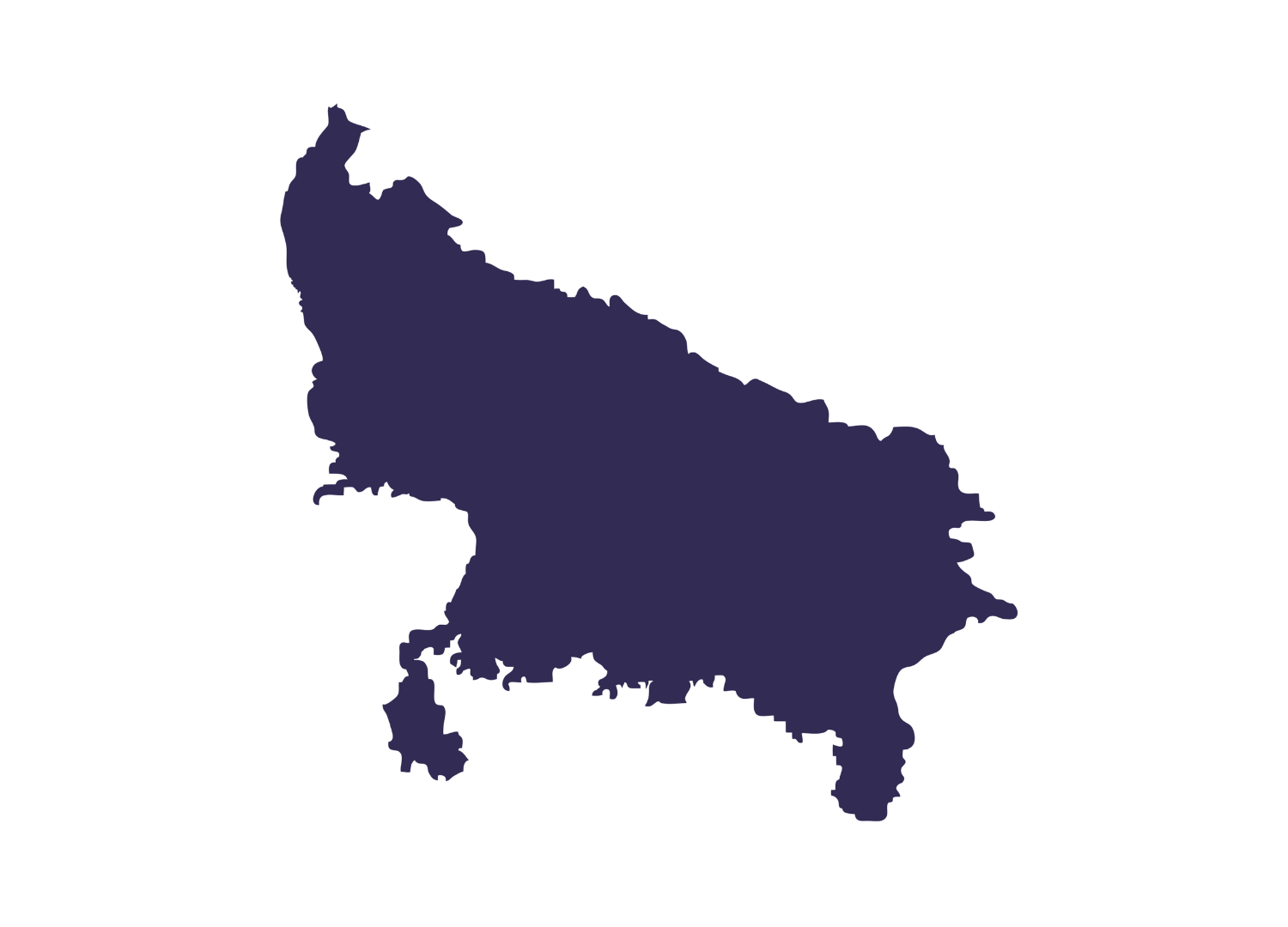
Located in the Indo-Gangetic plains, Uttar Pradesh is among India’s most fertile states thanks to the nutrient-rich silt and sediments deposited by major rivers like the Ganga, the Yamuna, the Gomti, and the Ghaghara. Over 31 major and minor rivers traverse the state, feeding its fertile soils and paving the way for large-scale irrigation and farming. The state shares borders with eight states and one union territory, and even shares an international border with Nepal. Uttar Pradesh is bordered by the Shivalik Mountains in the north, the Yamuna and Vindhyachal in the west and southwest, and the Gandak River in the east. The physiography can be divided into four main divisions: the Shivalik Range, the Bhabar and Terai region, the Gangetic Plains, and the Southern Plateau region.
Economy
As earlier said, agriculture is the bedrock of the state’s economy, although tourism and manufacturing are also major sources of employment. The state alone supplies over 21% of the country’s food, accounting for nearly 31% of wheat and 15% of rice. Uttar Pradesh is the third-largest state economy with a GDP of over INR 31 trillion. Major agro-based and FMCG companies like ITC, Parle Agro, and Haldiram Snacks have a base in the state to source, process, and package food products. Major industrial regions like Noida and Greater Noida have established manufacturing plants in sectors such as electronics, defence, and IT.
Tidbits
- Uttar Pradesh is the most populous state in India.
- It is home to Kashi, the oldest continuously inhabited city in the world.
- Lucknow is one of the only two cities in India designated by UNESCO as a Creative City of Gastronomy.
- Uttar Pradesh has produced the highest number of Prime Ministers in India – 9 in total.
- Uttar Pradesh is the largest producer of several agricultural commodities, including sugar, wheat, potatoes, lentils, guavas, amla, and milk.
- While Uttar Pradesh is only 76 years old, the region’s history dates back to 85,000 years and was home to the Aryan civilisation.
- Before the British and Mughals, the region was ruled by several dynasties, including the Nandas, Mauryas, Guptas, Palas, Vardhanas, and Gurjaras.
- Uttar Pradesh is called the Heartland of India, as it has significantly impacted India’s culture, history, economy, and even cuisine.
- Uttar Pradesh shares the most borders with other states – it shares 9 borders and 1 Union Territory.
- Parts of Uttar Pradesh were home to the Vedic Period.
- While Hindi is commonly spoken, over 5 regional variations of the language are spoken, including Bhojpuri, Bundeli, Braj Bhasa, Kannauji, and Awadhi.
- The state is considered the birthplace of several Hindu deities, including Lord Rama in Ayodhya and Lord Krishna in Mathura.
Call us at 9940882200 to learn more about our Uttar Pradesh tour packages.
Things To Know Before Choosing Uttar Pradesh Tour Packages
- The right time to book Uttar Pradesh tour packages depends on your interests. For instance, Agra is best explored in the winter, while the best time to visit Kashi is during Maha Shivaratri.
- Book your Mangal Aarti tickets on Ganga Ghat in advance to avoid the crowd.
- Make sure your travel operator offers private air-conditioned transport, and public transport can be crowded.
- Check if the package includes a tour guide for historic sites like Agra and Fatehpur Sikri, and to appreciate the local traditions in places like Kashi and Mathura.
- Pack plenty of sunscreen and basic hygiene products, as sanitation can be questionable in some places.
- Remember to include a food and heritage tour in cities like Lucknow to experience Nawabi cuisine and culture.
Uttar Pradesh At A Glance
| Category | Details |
| Capital City | Lucknow |
| Languages Spoken | Hindi, English, Urdu, Bhojpuri, Awadhi |
| High season | November to March |
| State Flower | Palash (Flame of the Forest) |
| State Animal | Barasingha (Swamp Deer) |
| State Tree | Ashoka Tree |
| Top Cities | Varanasi, Ayodhya, Lucknow, Agra, Mathura, Brindavan, Allahabad (Prayagraj), Sarnath, Fatehpur Sikri, Chitrakoot |
| Top Tourist Attractions | Kashi Vishwanath Temple, Ganga Ghats, Ram Mandir, Taj Mahal, Triveni Sangam, Bara Imambara, Banke Bihari Mandir, Jama Masjid, Buland Darwaza |
| Famous Food | Awadhi Cuisine, Kachori Sabji, Bedmi Puri, Tehri |
| Souvenirs to Buy | Banarasi Silk Saree, Chikankari Embroidery, Kannauj Attar, Marble Inlay Work, Brassware, Zardosi, Saharanpur Furniture, Meenakari, Banarasi Paan |
Planning a trip to the Heartland of India? Call us at 9940882200 to book our Uttar Pradesh tour packages.
Top Reasons To Choose Uttar Pradesh Tour Packages
Uttar Pradesh is a culturally rich state offering plenty of experiences to an inquisitive traveller. From the Mughal wonders of the Taj Mahal and Fatehpur Sikri to the Nawabi culture of Lucknow and the profound spiritual ecosystem of Kashi and Mathura, Uttar Pradesh is the ultimate assemblage of experiences. Read on to learn more about the different reasons to book Uttar Pradesh tour packages.
Historical Architecture
Uttar Pradesh was at the centre of the Mughal kingdom’s political and cultural influence. It was in Agra that the Mughal conqueror Babur established his capital. Many subsequent rulers, including Humayun, Akbar, Jahangir, and Shah Jahan, ruled from Agra, contributing to its architecture and art. Even after the capital was shifted to Delhi, the Mughals continued to build monuments in the region.
The most famous monument is the Taj Mahal, a mausoleum built by Shah Jahan for his beloved wife Mumtaz Mahal. His predecessor and father, Emperor Jahangir, also built several monuments, including a tomb for his father in Agra. Jahangir’s predecessor, Emperor Akbar, is a well-known connoisseur of art and architecture and built several monuments, including the imperial city of Fatehpur Sikri, the Agra Fort, the Allahabad Fort, and the tomb of Salim Chisti.
Ram Bagh (originally called Aram Bagh) is one of the oldest Mughal gardens built by Emperor Babur.
The Nawabs of Lucknow also contributed to the region’s architecture by building mosques, forts, palaces, and public monuments. The Bara Imambara is Lucknow’s grandest and most historic shrine. It features several architectural marvels, including the Bhool Bhulaiya, a labyrinth of balconies.
Rumi Darwaza, Chota Imambara, Husainabad Clock Tower, Kaisarbagh Palace, Chatar Manzil, and the Shahi Baoli are some of the other magnificent buildings commissioned by the Nawabs.
But it was not just the Mughals and Lucknows who contributed to the state’s architecture. The 17th-century Jhansi Fort is famous for its role during the 1857 First War of Independence.
Early Historical Influence
Between the 6th and 4th centuries BCE, the Mahajanapadas ruled and flourished, transforming India from individual tribal settlements into large, organised kingdoms. While the realms or kingdoms ruled from Afghanistan to the Deccan, Uttar Pradesh was the heartland of this era. Of the 16 Mahajanapadas, 7 were entirely located within present-day Uttar Pradesh. Great dynasties like the Guptas, Nandas, Mauryas, Shishunaga, Ikshvakus, and the Gandharas ruled places like Kosala (consisting of modern-day cities like Ayodhya, Lumbini, Gonda, etc.), Kashi, Panchala (consisting of modern-day Bareilly, Farukhabad, etc.), and Kuru.
While most of the monuments are now in ruins, some, like the Ghoshitarama Monastery and the Jeevatana Monastery, have been unearthed by archaeologists. They have also discovered Painted Grey Ware and Northern Black Polished Ware artefacts from the Vedic Age at Ahichhatra, near Bareilly. This place served as the capital of the Panchala Mahajanapada and was ruled by King Drupad in the Mahabharata. The Dashavatara Temple, built in the 6th century, during the Gupta Period in Deogarh, Lalitpur, is also a famous medieval monument.
When in Allahabad, don’t miss the stone pillar, originally erected by Emperor Ashoka. It also contains inscriptions during the Gupta and Mughal periods.
Sarnath and Varanasi, which were part of the Kashi Mahajanapada, are home to pre-Buddhist era burial mounds built by local tribes.
Archaeologists have uncovered Painted Grey Ware and Northern Black Polished Ware from Mathura, which was the capital of the Surasena Mahajanapada.
If you’re interested in exploring real places like Bharnawa (Lakshagraha) and Hastinapur from the Mahabharata, don’t forget to ask our tour manager to include them in your Uttar Pradesh tour packages itinerary.
Spiritual Destinations
Uttar Pradesh embodies India’s spiritual heritage. It is not only the monuments that make this place sacred, but rather its deep connection to India’s ancient civilisation. From the Ganga Ghats in Kashi to Ayodhya and Mathura, the birthplaces of Lord Rama and Lord Krishna, respectively, to the Buddhist ruins of Kushinagar, Sarnath, and Shravasti, spiritual life in Uttar Pradesh never stopped.
Kashi, also called Benaras and Varanasi, is the oldest continually inhabited city in the world, and is referenced in texts as old as the Rigveda. The Kashi Vishwanath Temple is the nucleus of this city and is believed to be over 1000 to 3000 years old. While it was destroyed several times in history, the present structure was built by Rani Ahilyabai Holkar in 1780.
Allahabad, or Prayagraj, is of immense importance to Hindus because of the Triveni Sangam, the sacred confluence of the Ganga, the Jamuna, and the mythical Saraswati. It is also on the banks of the Triveni Sangam that the Maha Kumbh, Purna Kumbh, and Ardh Kumbh Melas are held every 144, 12, and 6 years, respectively.
Ayodhya is believed to be the birthplace of Lord Rama. Nestled on the banks of the Sarayu River, the city is home to several ancient temples and ghats with tales referencing the Ramayana. Devotees believe that a dip in the holy waters of Sarayu can purify one’s soul.
Mathura and Brindavan are closely associated with the legend of Lord Krishna. He was born in a prison cell in Mathura, but later moved to a nearby village, Gokul, to prevent King Kamsa from killing him. At the age of 3, his foster parents moved the family to Brindavan, where he performed his Leelas. Later, he moved to Nandgaon, near Barsana, which is where he met Radha. All of these places are located in Uttar Pradesh and can be included in your Uttar Pradesh tour packages.
Uttar Pradesh is also an important Shakti Peeth, with famous temples such as the Katyayani Devi Shakti Peeth and the Vindhyavasini Devi temples in Vrindavan and Vindhyachal, respectively. Other famous Shakti temples include Jwala Devi in Sonbhadra, Lalitha Devi in Sitapur, Shivani Devi in Chitrakoot, and Sita Samadhi in Bhadohi.
And if you are interested in the Ramayana circuit, call us to include a curated pilgrimage route tracing the Ramayana’s journey when booking your Uttar Pradesh tour packages. Besides Ayodhya, the route will include Chitrakoot, Bithoor, Sultanpur, and Shringverpur.
If you are interested in exploring Buddhist ruins and places associated with the Buddha, book our Buddhist circuit. It includes cities like Sarnath, Kushinagar, Shravasti, Kapilavastu, Sankisa, and Kaushambi.
The Mughals and rulers of the Delhi Sultanate built several mosques, including the Jama Masjid and Moti Masjid in Agra, the Jama Masjid in Fatehpur Sikri, the Alamgir Mosque in Varanasi, and the Shahi Jama Masjid in Sambhal. The Sambhal mosque was built in the 16th century by Babur, and is the oldest Mughal-era Mosque in South Asia.
Cuisine
Food and spirituality are the two main attractions of Uttar Pradesh. In fact, besides Hyderabad, Lucknow is the only city in India recognised by UNESCO as a City of Gastronomy. From melt-in-your-mouth Galouti Kebabs and fragrant Biryani to dessert delicacies like Agra’s Petha and Mathura’s Peda, the state boasts a culinary heritage that’s as diverse as its landscape.
At the centre of this gastronomical experience is Awadhi cuisine, famous for its Galouti Kebabs, Biryani, Nalli Nihari, Kakori Kebab, Mutton Korma, Boti Kebab, and Shami Kebab.
There’s so much to explore for vegetarians as well. From Bedmi Puri and Tahiri, to Sheermal, Kulfi Falooda, Bati Chokha, Kachori Sabji, and Matar ke Nimone, vegetarians will not be disappointed.
There are plenty of regional variations as well. For instance, Awadh is famous for its Nawabi cuisine, and features dishes made with rare ingredients and elaborate cooking techniques. In contrast, Bundelkhandi cuisine is known for its robust flavours and use of hyperlocal ingredients. Braj cuisine is largely vegetarian and influenced by Vaishnavism. The food is mostly Satvic (without onion and garlic) and uses dairy products like milk, Ghee, and butter. When in Mathura, you must try their Chappan Bhog, a traditional Thali featuring 56 food items that are offered to Lord Krishna during Janmashtami.
The region is equally famous for its desserts, including the winter speciality Malaiyyo. Some of the sweets you must sample with your Uttar Pradesh tour packages include Agra Petha, Mathura Peda, Blue Lassi of Varanasi, Khurchan, Malpua, and Kulfi. When in Mathura, don’t miss the Makhan Misri, a favourite of Lord Krishna.
Wildlife Sanctuaries
Wildlife reserves and national parks are a major part of Uttar Pradesh tourism. The state’s rich biological diversity, such as the Terai Belt, the Gangetic Plains, the Vindhya Plateau, and the riverine ecosystem, has been conducive to wildlife conservation.
The Dudhwa National Park, the only national park in the state, is part of the Terai Ecosystem and home to several wildlife species, including the Barasingha, the state animal, elephant, and the one-horned rhinoceros.
The National Chambal Sanctuary near Agra -Etawah is part of the state’s riverine ecosystem and home to several wildlife species, including the critically endangered Gharial, the Gangetic dolphin, the Muggar, and the Otter.
The state has over six tiger reserves, including Pilibhit and Ranipur. Some of these are tiger and elephant corridors ensuring free movement of these animals from major reserves like Corbett in Uttarakhand and Bardia in Nepal.
Uttar Pradesh has several bird sanctuaries, such as Bakhira and Samaspur, where migratory birds from Central Asia visit the wetlands. Some of the birds you will find here include several species of waterfowl, mallards, white-eyed porchards, and the great crested grebe.
Call us at 9940882200 to book our Uttar Pradesh tour packages.
Festivals
Uttar Pradesh hosts over 40 festivals and 2000 fairs, including the great Kumbh Melas, celebrated every 144, 12, and 6 years. A record number of people attend the Kumbh Melas, which is often considered the world’s largest religious gathering, drawing over 500 million devotees.
Every year, during Diwali, Ayodhya celebrates Deepotsav, a festival that includes lighting over a million earthen lamps, or Diyas, on the banks of the Sarayu and across the city. It is done to recreate the scene from the Ramayana, when Ayodhya’s residents lit lamps across the city to welcome Lord Rama upon his return after 14 years. Among other things, the festival includes reenactments of various Ramayana scenes, laser shows, and Shobha Yatras.
The Taj Mahotsav is a cultural festival that celebrates dance and music from across India. It is held in winter every year. While Holi is celebrated with fanfare across the state, the festival is slightly different in Barsana, the supposed native village of Radha. Called Lathmar Holi, the women here playfully hit men with sticks while the latter run for cover across the streets. This event is believed to recreate the scene when Lord Krishna visited Barsana to drench Radha, but was chased away along with his friends.
Don’t miss the Hot Air Balloon Festival celebrated during winter, along the Ganga ghats of Varanasi. The city also celebrates Dev Deepawali, a festival held 15 days after Diwali to honour Lord Shiva and his victory over the demons Vidyunmali, Viryavana, and Tarakaksha.
Best Time To Choose Uttar Pradesh Tour Packages
Uttar Pradesh has a humid subtropical to tropical monsoon climate with hot summers, heavy monsoon, and cool winters. But in a state as large as Uttar Pradesh, regional variations exist. For instance, the Upper Gangetic plains (Meerut, Agra, Aligarh, etc.) can reach summer temperatures of up to 45°C, while semi-arid tropical places like Lalitpur experience scant rainfall and extreme summers.
Summer (March to May)
Summer in Uttar Pradesh is hot and dry, with average temperatures ranging from 32°C to 39°C, and can reach 45°C, accompanied by dust-laden hot winds called Loo. Sometimes, temperatures could even touch 48°C. These dust-laden winds can cause severe damage, including power outages and ruin crops and vegetables. The scorching heat isn’t encouraging, but if you’d like to experience some of Uttar Pradesh’s popular festivals like Holi and the Ganga Dussehra. Holi is especially celebrated with great fanfare in the state. Lathmar Holi is a popular festival in the towns of Barsana and Nandgaon (near Mathura), the birthplaces of Radha and Lord Krishna’s foster parents, respectively. It is also the time to visit the state’s national parks and sanctuaries as the scorching sun forces animals to gather around the watering hole.
Another advantage of visiting Uttar Pradesh during summer is that popular tourist spots like the Taj Mahal open as early as 6.00 am to help you beat the heat. Hotel accommodations are cheap, and tourist spots are less crowded, making it an ideal time to explore budget Uttar Pradesh tour packages.
Monsoon (June to September)
Uttar Pradesh receives almost all of its annual rain during this season, ranging from 900 to 1000 mm, with some regions in the east and southeast receiving around 1000 to 2000 mm. The Himalayan foothill regions of Saharanpur, Pilibhit, and Maharajganj receive the most rainfall. Monsoon brings temperatures down to a tolerable 25°C to 30°C, making it ideal for travel. However, we suggest you check the weather forecast before booking Uttar Pradesh tour packages during this season, as floods are common along the banks of the Ganga, Jamuna, and Gomti. Many travel agencies and hotels offer off-season discounts to attract tourists during this period.
Some of the festivals celebrated during the monsoon in Uttar Pradesh include Teej, Krishna Janmashtami, Nag Panchami, and the Jhulan Yatra. Janmashtami is especially famous in Mathura and Vrindavan, two places associated with the legend of Lord Krishna.
Winter (October to February)
This is undoubtedly the best time to book Uttar Pradesh tour packages, when temperatures range from 10°C to 25°C and can even drop to 3°C in January. Besides the top tourist attractions like Agra and Fatehpur Sikri, food lovers also visit the state during these seasons to enjoy its winter delicacies, such as Matar ka Nimona, Gajar Halwa, and Makhan Malai (Malaiyyo). Since it is tourist season, places are likely to be crowded, so remember to book tickets in advance, especially if you plan to attend the Ganga Aarthi. Besides festivals like Diwali and Ganga Mahotsav, the government also organises events such as the Taj Mahotsav to promote tourism. The event features classical and folk arts from across India, along with showcasing the state’s different regional cuisine. Some of the other events and festivals to enjoy during this season include the Lucknow Mahotsav and the Bateshwar Livestock Fair in Agra.
Top Tourist Attractions In Uttar Pradesh
Taj Mahal
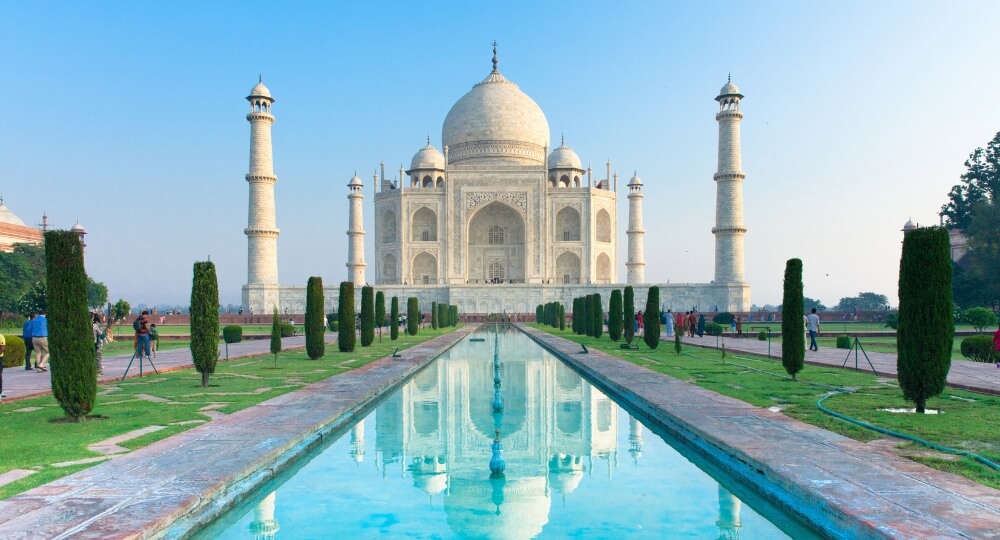
The Taj Mahal is deservedly considered among the Seven Wonders of the World and is a UNESCO World Heritage Site. It was commissioned in the 17th century by Mughal Emperor Shah Jahan for his wife Mumtaz Mahal, who passed away during childbirth. Made using Makrana marble from Rajasthan, the mausoleum is based on Indo-Islamic architecture and is famous for its perfect symmetry. The walls feature floral motifs embossed in Pietra Dura, with semi-precious stones such as jade, jasper, and yellow marble inlaid into white marble. The entire complex includes the mausoleum, the main gateway, a red sandstone mosque, the Jawab (on the east to mirror the mosque on the west), and a Persian garden.
Agra Fort
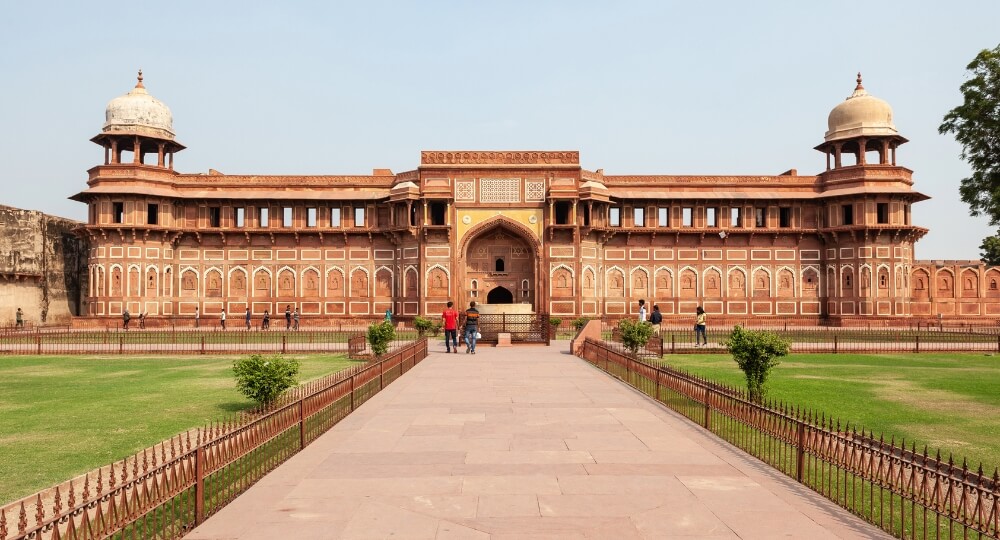
A UNESCO World Heritage Site, the Agra Fort was built by Emperor Akbar. It was considered impregnable because of its formidable design, including massive double ramparts, deep moats, and deceptive entrances. Today, the fort is managed by the Indian Army, with entrance restricted to the Amar Singh Gate. The 94-acre fort features several buildings, including Jahangir Mahal, Shah Jahan Mahal, Khas Mahal, Anguri Bagh, Diwani-i-Khas, Sheesh Mahal, Machhi Bhavan, Diwani-i-Am, and Ratan Singh ki Haveli. Among other things, make sure you don’t miss the Jahangir Hauz, a large bathtub carved out of a single sandstone and once filled with rose water for the emperor’s bath. The Takht-e-Khas, or the Throne of Jahangir, is also worth seeing – the 3-metre-long black onyx slab was imported from Belgium and inscribed with Persian slogans praising Jahangir.
Itmad-ud-Daula’a Tomb
This is a lesser-known but equally magnificent monument of the Mughal era. Located on the banks of the Jamuna River, the tomb is dedicated to Mirza Ghiyath Beg, the father of Nur Jahan. It was perhaps the first tomb built on a riverbank and is also known as the Baby Taj for its architectural similarities. It was also the first monument to use the Pietra Dura style. When visiting the tomb, don’t miss the intricately carved floral patterns and the marble lattice screenwork. The entire building is designed to resemble a jewel box placed amidst a garden.
Akbar’s Tomb
Akbar’s tomb is in Sikandra, a suburb of Agra, about 12 km from the city. This grand mausoleum was planned by Akbar but completed by his son, Jahangir, in 1613. Built of red-ochre sandstone and featuring animal and floral motifs, the mausoleum is a four-tier structure, with the top storey clad in white marble. Also, like other tombs, the actual grave of Emperor Akbar lies in the basement and is unadorned, but the false tomb is intricately adorned. The architecture reflects Akbar’s liberal religious outlook by incorporating Persian and Hindu elements. The emperor’s favourite wife and Jahangir’s mother, Mariam’s tomb, is located close by.
Jama Masjid
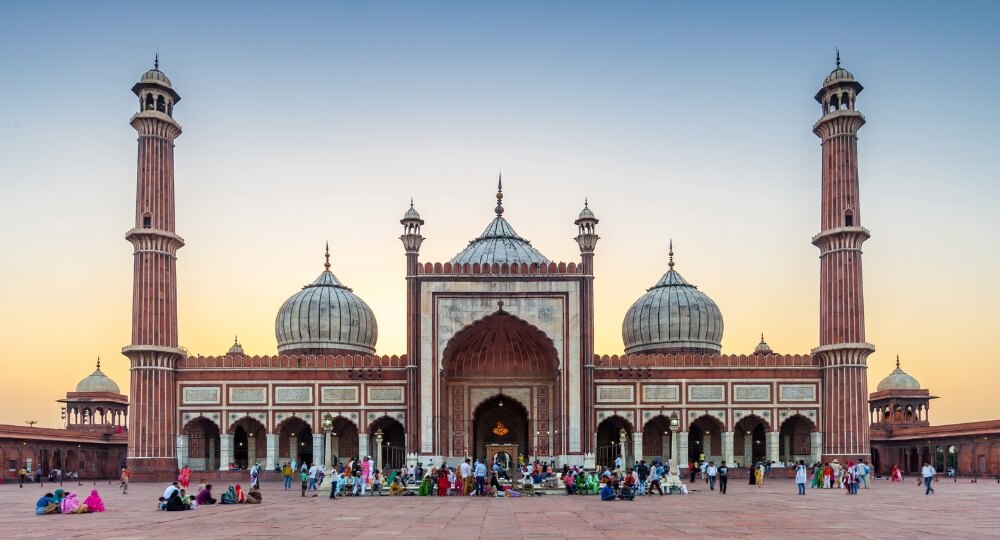
The Jama Masjid in Agra was commissioned by Emperor Shah Jahan but was supervised by his daughter, Jahanara Begum. It is smaller than the Jama Masjid in Delhi, but grand nonetheless. It is located opposite the Agra Fort and is famous for its red-sandstone architecture, featuring Quranic verses in decorative calligraphy. When visiting the Masjid, don’t forget to check the perfect geometric symmetry in the architecture, especially the herringbone pattern of red and white sandstone design on the domes and the twin columns. It is widely believed that the Jama Masjid was among the last of such imperial mosques, as later rulers primarily built smaller and private monuments.
Fatehpur Sikri
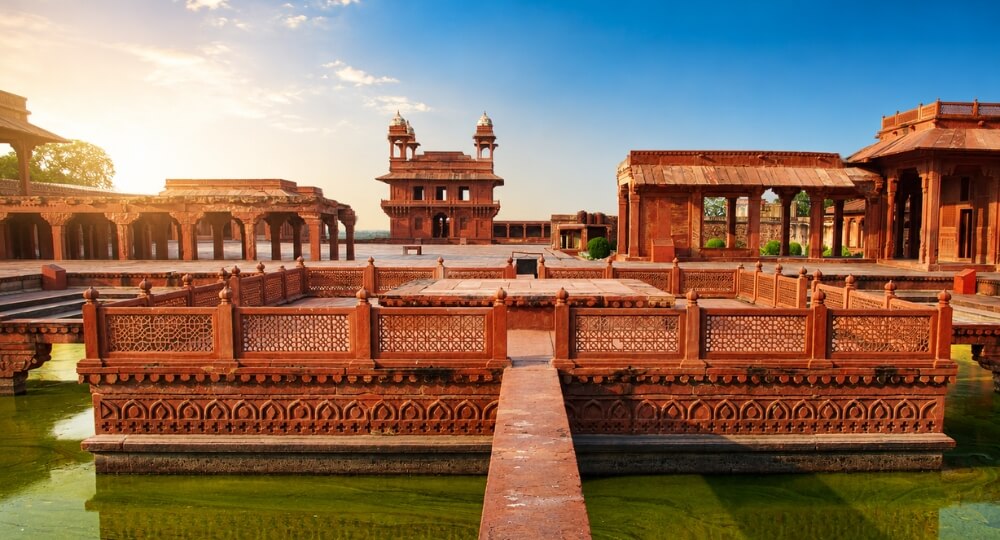
Fatehpur Sikri is a fortified city built by Emperor Akbar in the 16th century. It served as his capital for almost a decade. The entire complex beautifully blends Persian, Indian, and Islamic architectural styles. Made largely using red sandstone, it includes several monuments like the Buland Darwaza, Panch Mahal, Jama Masjid, the Tomb of Salim Chisti, Diwani-i-Aam, Diwan -i-Khas, Ibadat Khana, Anup Talao, Jodha Bai Mahal, Naubat Khana, Birbal’s House, and Hiran Minar. Akbar later abandoned the city due to persistent water shortages and his ambitions to conquer farther north. His son, Jahangir, later ruled from the city for three months, when a plague had taken over Agra. The city was later abandoned until archaeologists took an interest in it in 1892.
Kashi Vishwanath Temple
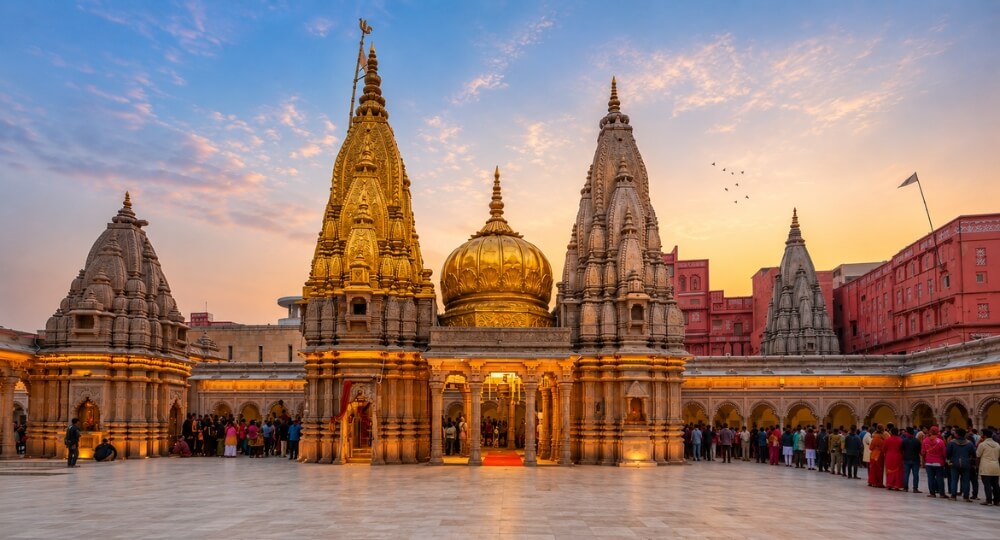
The Kashi Vishwanath Temple is the first of the 12 Jyotirlingas and is dedicated to Lord Shiva, who is worshipped as Vishwanath, or Lord of the Universe. It is believed that the temple could be several thousand years old, but was destroyed and subsequently rebuilt. The current structure was constructed by Rani Ahilyabai Holkar after it was destroyed by Aurangzeb in 1669. In 1830, Maharana Ranjit Singh donated 1,000 kg of gold to help build the temple’s domes, giving it the name “Golden Temple”. Unlike in other temples, where Lord Shiva is known to visit, devotees believe that he rules the earth from Kashi. Hindus believe that visiting the temple along with a dip in the Ganges grants Moksha to a spiritual seeker.
Ganga Ghat
Ganga is considered one of the holiest rivers in India, especially when it reaches Kashi, as it is from here that she begins to flow northwards, believed to be an ascent towards spirituality. Hindus believe that a holy dip in the river delivers a person from rebirth and grants Moksha or salvation. Over the centuries, multiple Hindu kings, wealthy merchants, and landowners. There are over 84 Ghats, though some lists put the total at 88, depending on water levels and subdivisions. Manikarnika is considered the oldest and most sacred of all these Ghats, and is among the only two used for cremation, the other being Harishchandra Ghat. These embankments, originally constructed to prevent soil erosion and flooding, later became places for cultural gatherings. Today, people perform rituals, offer flowers and incense, practice yoga and meditation, sell street food, or even play classical music. The famous Ganga Aarti is performed on the Dashashwamedh Ghat, as Hindus believe that Brahma performed the Ashwamedh sacrifice here. The Assi Ghat is also popular, as it was here that Tulsidas completed the Ramcharitmanas.
Benaras Hindu University
India’s first central university and the largest residential university in Asia, the Benaras Hindu University was founded by Pandit Madan Mohan Malviya. The serene 1300-acre campus is a pleasant diversion from the chaotic atmosphere of Kashi. As tourists, you can explore the university either on a rented cycle or by hiring an auto. Besides the greenery, popular attractions on campus include the Birla Temple and the Bharat Kala Bhavan Museum.
Banke Bihari Temple
The Banke Bihari Temple in Brindavan is dedicated to Lord Krishna. Legend has it that the idol was discovered by Swami Haridas, a 16th-century saint, in the sacred grove of Nidhivan. The deity gets his name from Lord Krishna’s pose – he is believed to be in the Tribhanga pose, symbolising grace, poise, and devotion. The deity here does not offer continuous Darshan, and a curtain is drawn regularly, as it is believed that if one stares long enough into Lord Krishna’s eyes, one would lose one’s self-consciousness.
Bara Imambara
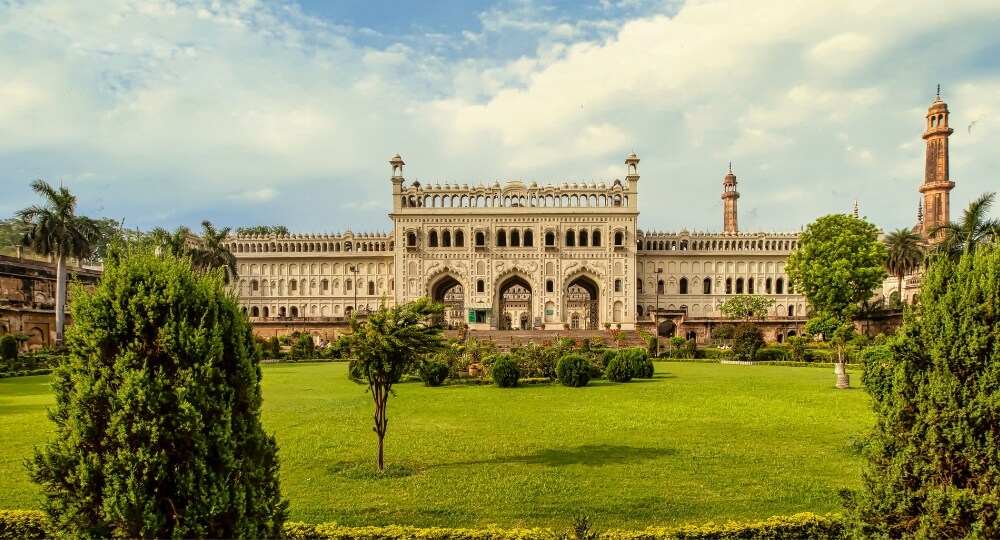
Lucknow’s most popular tourist attraction, the Bara Imambara, has an interesting backstory. It was commissioned by the Nawab Asaf ud Daula to provide employment to his subjects struggling from a ravaging famine. Even today, the monument stands tall as one of the largest prayer halls of the Shia Muslims in India. To ensure continued employment, the Nawab had the commoners build the monument by day, and the elite dismantle parts of it by night. Others claim that elite architects worked at night to protect the building’s engineering and structural design details. The highlight of the monument is Bhool Bhulaiya, an intricate labyrinth that features a complex network of doorways and passages. Locals believe that while there are more than a thousand ways to enter the labyrinth, one can exit only through two doorways.
Chota Imambara
Also called the Husainabad Imambara, this prayer hall was built by Nawab Mohabbat Ali Shah, who is also buried here along with his mother. As the name suggests, the Imambara is small, but what it lacks in size it more than makes up for in opulence. The hall is filled with chandeliers and clocks from Belgium and Paris – so much so, the British once called it The Palace of Lights.
Husainabad Clock Tower
Also called Ghantaghar, the clock tower in Husainabad is the tallest in India, standing at approximately 67 metres. The tower was designed by Richard Bayne in 1881 and commissioned to welcome the first Lieutenant Governor of the United Province of Awadh, Sir George Couper. It resembles the Big Ben in London, featuring a large 14-foot pendulum and made of gunmetal. The clock had been inoperative for a long time, but two young men repaired it in 2010 to prevent this historic monument from being replaced.
Dudhwa National Park
The Dudhwa National Park is the only national park in Uttar Pradesh and was established in 1977. Today, the park covers around 490 square kilometres and is located in Lakhimpur, near the Indo-Nepal border. Among other animals, you will find tigers, leopards, elephants, sloth bears, and over 450 bird species. The rich Terai-Bhabar ecosystem and marshy grasslands attracts millions of migratory birds, including ospreys, Sarus cranes, hornbills, woodpeckers, and the Bengal florican. As part of your Uttar Pradesh tour packages, guests can stay inside the park’s rest houses and even book a safari or forest tour.
Shravasti
Shravasti is one of the eight pilgrimage places associated with Gautama Buddha. It was here that he manifested himself a million times while seated on a thousand-petaled lotus. He also emanated fire and water from his body, thereby giving this place the name The Twin Miracle. Buddhists believe that the Buddha spent 24 Chaturmases (a four-month period during which monastics had to remain at one monastery and dedicate themselves to intense meditation and study) at the Jetavana Monastery. Tourists can visit the Sahet-Mahet archaeological site, which features the Jetavana Monastery, the Angulimala Stupa, and the Vipassana Meditation Centre. Shravasti is also home to the Shobhnath Temple, the birthplace of the Jain Tirthankara, Sambhavanath.
Don’t miss the Anandabodhi Tree, planted by Ananda, a disciple of the Buddha, from a sapling of the original Bodhi tree. You can also check the low walls and brick platforms where the Buddha resided and meditated.
Dhamek Stupa
The Dhamek Stupa in Sarnath was built in 500 CE to replace an earlier structure built by King Ashoka in 249 BCE. It is an imposing, cylindrical stupa made using stone and bricks and adorned with floral carvings that belong to the Gupta period. The stupa is located in the middle of a deer park – the exact place where Buddha is believed to have delivered his first sermon after attaining enlightment. The Buddhist called this moment, Dharma Chakra Pravartana. It was here that he delivered the Eightfold Path, making it one of the holiest spots for Buddhists. Close to the Dhamek Stupa is the Sarnath Museum that houses ancient artefacts from the 3rd to the 12th centuries. The best time to visit this place would be during Buddha Purnima or Vesak, a day believed to be Buddha’s birthday.
Ashoka Pillar
Also called the Allahabad Pillar, the Ashoka Pillar is a 10.5 metre sandstone monument erected almost 2000 years ago in 232 BCE, originally erected by Emperor Ashoka. The pillar also includes inscriptions about Emperor Samudragupta of the Gupta Empire and by Emperor Jahangir in the 17th century. Since the pillar is within the Allahabad Fort, you will explore it as part of your Uttar Pradesh tour packages.
Sarnath Archaeological Museum
The Sarnath Archaeological Museum was established in 1910 to preserve the antiques found at the excavation site in Sarnath. The museum contains five galleries and includes artefacts from the 3rd century to the 12th century CE. Some of these include terracotta structures, baked bricks and pots, images of Jain Tirthankaras, and images of the Buddha preaching. The museum’s main attraction is undoubtedly the Lion Capital that once adorned the Ashoka Pillar. Carved out of a single Chunar sandstone and measuring around 2.3 metres, this highly polished sculpture also features an inverted lotus, a round abacus, and four running animals – an elephant, a bull, a horse, and a lion.
Sri Krishna Janmabhoomi
The Sri Krishna Janmasthan is a temple complex believed to have been built on the exact spot where Lord Krishna was born. The complex contains three buildings – the Keshavdev Temple, Garbha Griha, and Bhagavata Bhavan. It is in the Garbha Griha where the lord was born within a prison cell.
Mathura Museum
The Government Museum of Mathura was established in 1874 by F.S. Growse, an eminent archaeologist. It initially contained the private collection of Fredrick Growse, which was obtained from Mathura and nearby areas. The government later added other items, including manuscripts, sculptures, decorative panels, and even sculptures of the Bodhisattva. The museum contains over 6,000 artefacts dating back to the Gupta and Kushan periods, including notable pieces such as the headless statue of Kanishka.
Govardhan Hill
The Govardhan Hill is also called Giriraj Ji, and is located in Braj, a region associated with Lord Krishna’s childhood. It is rather a sandstone ridge that stretches 8 km long and rises over 25-30 metres above the ground. It is believed that the hill was once huge and supported forests and water resources. Millions of years of geological erosion have reduced it to its current size. Today, millions of devotees walk around the hill in a ritual called Parikrama. While doing so, they visit places associated with Lord Krishna, including Radha Kund, a pond dug by Radha and the Gopis; Mansi Ganga, a lake manifested by Lord Krishna; and the Samadhi of Srila Raghunatha Dasa Goswami, the Acharya of the Gaudiya Vaishnavs.
Jhansi Fort
This magnificent 17th-century fort is associated with the legend of Rani Laxmibai, especially her legendary jump from the Banderi Gate on her horse with her son tied to her back. The location is now called Jumping Point and is a major tourist attraction within the fort. The fort, constructed by King Bir Singh Judeo of Orchha still looks formidable. Besides the Banderi Gate, you can visit the fort’s other nine gates, including Khanderao, Datia Darwaza, Orchha Gate, and Chand Gate. Another attraction within the fort is the Kadak Bijli Toup, a lion-headed cannon used during the 1857 Revolt.
Rani Mahal
This 18th-century palace was the royal residence of Rani Lakshmi Bai. It is a two-storeyed building featuring multiple rooms, including a Durbar Hall and a central courtyard. Much of the palace was destroyed by the British during the siege of 1858. It was here that she was approached by the Indian fighters, who urged her to take the lead in the revolt. And it was here that she claimed to never give away her Jhansi – Main Apni Jhansi Kabhi Nahi Doongi. The palace features interesting motifs, decorated arches, and intricate Jaaliwork.
Mahalakshmi Temple
Situated on the banks of the Lakshmi Lake, the Mahalakshmi Temple is the family deity of the Maharajas of Jhansi. It was built in the 18th century by Raghunath Rao Newalkar. The temple is closely linked to the legend of Rani Laxmibai, who used to pray here every day. It also has a tunnel that connects it to the Jhansi Fort.
Prem Mandir
This is a Hindu temple located in Vrindavan, Mathura and spread across 55 acres. The temple has two levels, Radha and Krishna on the first and Sita and Lord Ram on the second. It was developed by Jagadguru Shri Kripalu Maharaj and is considered one of the most beautiful temples of Vrindavan.
Rumi Darwaza
The iconic Rumi Darwaza in Lucknow is a 60-foot gateway built by Nawab Asaf-ud-Daula to provide employment to the locals during a devastating famine. The gate’s design resembles the Sublime Porte in Istanbul. The gate features intricate carvings from both sides of the base, rising to the arch and surrounded by a turret. It is constructed using burnt clay and lime-crushed brick aggregate mortar.
Hazratganj
Lucknow’s central business hub and a historical market, Hazratganj was established in 1810 by the Nawab of Awadh. The market was historically called Ganj-e-Sabun, meaning “soap market,” as it was a major hub for the soap trade in the 18th century. Some of the key landmarks within the market include Tundey Kebabi, Prakash Kulfi shop, Ram Asrey and Novelty Cinema. Not to mention, the Royal Café, which is famous for its biryani and kebabs.
Triveni Sangam
Triveni Sangam refers to the sacred confluence of three water bodies. The Triveni Sangam in Allahabad or Prayagraj is especially important as it is the confluence of the sacred Ganga, Yamuna, and the mythical Saraswati. The Triveni Sangam is famous for the Kumbh Mela, the largest peaceful religious gathering in the world. Devotees can distinguish between the two water bodies easily – while the Ganga is muddy and shallow, the Yamuna is deeper and appears deep blue. It is believed that drops of nectar from the Samudra Manthan fell here, making the waters pure and sacred. Taking a dip in the waters purifies one’s soul and grants Moksha.
Ram Janmabhoomi Mandir
The Ram Janmabhoomi Mandir in Ayodhya is a grand temple built in 2024 on the site believed to be the birthplace of Lord Ram. The temple, built in the Nagara style, does not feature iron or steel and is entirely made of interlocking stones. The 70-acre complex features a pilgrimage facilitation centre, a museum, and a Yagshala.
Kanak Bhavan
Kanak Bhavan, or the Golden Palace, is one of Ayodhya’s most prestigious temples, dedicated to Lord Ram and Sita. It is believed to have been built on the palace that Queen Kaikeyi gifted to Sita after her wedding. The current structure of the temple was built in 1891 by Vikramaditya in Bundelkhandi architecture. It features three pairs of idols depicting the Lord and Sita adorned in gold. The best time to visit the temple is between April and July during the Phool Bangla festival, when the entire complex is decorated in flowers, and during the Jhula Festival, celebrated to welcome the monsoon. Close to the temple is the Guptar Ghat, where Lord Ram is believed to have taken Jal Samadhi.
Allahabad Fort
Emperor Akbar built this majestic fort on the banks of the Triveni Sangam in the 16th century to serve as a military and administrative base. Over the years, the city grew around the fort. The fort has witnessed multiple historic moments, including Prince Salim’s rebellion, who later came to be known as Emperor Jahangir. The fort was also at the centre of the 1765 Treaty of Allahabad and the 1857 Uprising. It is the largest fort built by Akbar and features massive ramparts, multiple towers, and historic gates such as The Delhi Gate and The Chalees Satoon ki Masjid. The Ashoka Pillar, dating to 232 BCE, is located within the fort and was relocated from Kaushambi. It is also home to Saraswati Koop, a well believed to be the origin of the mythical Saraswati. Some of the other things you can explore with your Uttar Pradesh tour packages within the fort include the Patalpuri Temple and Akshayavat.
Anand Bhavan
This historic house, now a museum, was once the abode of the Nehru family. It was built in the 1930s by Motilal Nehru and witnessed multiple historic events, including the drafting of the Nehru Report and the strategising of the Quit India Movement. The former Prime Minister Indira Gandhi converted the home into a museum in 1970 to preserve its legacy.
National Chambal Wildlife Sanctuary
The National Chambal Wildlife Sanctuary is located on the Chambal River and is home to the critically endangered Gharial and the endangered Ganges dolphin. Other animals found within the sanctuary include smooth-coated otters, various turtle species, and over 30 fish species. As part of your Uttar Pradesh tour packages, you can explore the sanctuary through a boat safari or sign up for birdwatching.
Call us at 9940882200 to learn more about our Uttar Pradesh tour packages.
Top Cities In Uttar Pradesh
Agra
The city of Agra is one of the most visited cities in Uttar Pradesh and a key point in India’s famous Golden Triangle tourist circuit. Although Sultan Sikandar Lodi is credited with building the city, it has been inhabited since the Mahabharata and even featured an older prison fort by the Mathura kings. It was probably called Agravana, meaning forest paradise, or Arya Griha, the abode of the Aryas. The city was the capital of several rulers, including Sultan Sikandar Lodhi, his son, Sultan Ibrahim Lodhi, and Mughal Emperors Babur, Akbar, Jahangir, and Shah Jahan. During the Mughal rule, the city was called Akbarabad. Since it was the seat of power of the Mughals, they built several notable monuments, including the Aram Bagh (Babur), Agra Fort (Akbar), Taj Mahal (Shah Jahan), Jama Masjid (Jahanara Begum), Akbar’s Tomb (Jahangir), and Itimid-ud-Daula (Nur Jahan). Almost all of these are included in your Uttar Pradesh tour packages.
Fatehpur Sikri
This breathtaking 16th-century city was founded by Akbar to honour Salim Chisti, the Sufi saint who prophesied the birth of his son. The city even served as his capital until 1585, when Akbar abandoned it due to a water shortage and his ambitions to conquer farther north. His son, Emperor Jahangir, ruled from here for a brief time when a devastating bubonic plague ravaged Agra. After that, the city remained largely deserted and was even called Ghost City until it was rediscovered by a British archaeologist in 1892. Among the 30-something monuments, some of the popular ones include Buland Darwaza, the Tomb of Salim Chisti, Jama Masjid, Panch Mahal, Jodha Bai Palace, Anup Talao, Birbal’s House, Hiran Minar, Diwan-i-Khas, Diwan-i-Aam, and Nagina Masjid.
Lucknow
Uttar Pradesh’s capital and largest city was once the seat of power of the Nawabs in the 18th and 19th centuries. The city’s history dates back to the Ramayana, with the locals believing that it was founded by Lakshmana. The modern city was founded by Nawab Asaf-ud-Daula in 1775 when he transferred the capital of the kingdom of Awadh from Faizabad to Lucknow. Located on the banks of the Gomti River, Lucknow is one of India’s only two cities to be declared UNESCO’s City of Gastronomy. The city’s cuisine, culture, and architecture feature a blend of Nawabi and Mughal influences. The Nawabs, known for their refined tastes, helped develop regional music, dance, and food. At its zenith, Lucknow was called the Constantinople of the East. Some of the monuments you will visit with your Uttar Pradesh tour packages include the Bada Imambara, Chota Imambara, Hazratganj, Rumi Darwaza. Besides Chikankari and Kathak, don’t forget to explore the city’s markets to buy exquisite handicrafts like Zardozi, Mukaish work, Banarasi sarees, attar, and Zarbuland work. Not to mention, the famous Awadhi cuisine – Biryani, different varieties of kebabs and breads, Nihari, Sheermal, Murgh Musallam, and Malaiyyo.
Kanpur
Located on the banks of the Ganga River, Kanpur is an industrial city famous for its tanneries and textile mills. But the city is as old as history, dating back to the Mahabharata – locals believe that it belonged to Karna, while others believe it was founded by Raja Hindu Singh Chandel of the Sachendi and named Kanhapur after Lord Krishna. Kanpur played an integral part in the Indian freedom struggle – it was at the epicentre of the 1857 Uprising and even helped establish the Communist Party of India. Some of the places you can visit in Kanpur include Bithoor, where Sage Valmiki is believed to have composed the Ramayana and where Luv and Kush, the sons of Lord Rama, are said to have been born. Besides Bithoor, you will visit Allen Forest Zoo, JK Temple, Kanpur Memorial Church, Nana Rao Park, and Phool Baugh. And if you love food, don’t miss iconic eateries like Thaggu ke Laddu for their Badnaam Kulfi, dry fruit Ladoo and Baba Biryani.
Prayagraj
Prayagraj, formerly known as Allahabad, is a historic city located at the confluence of three sacred rivers: the Ganga, the Yamuna, and the mythical Saraswati. It is among India’s oldest cities and mentioned in Vedic texts, where it was referred to as Tirtha Raja, or King of Pilgrimage Sites. It is also mentioned in texts like the Ramayana and the Mahabharata. The Brahma Puran even mentions that bathing at the Triveni Sangam in the Hindu month of Magha bestows on a person benefits that equal those of a million Ashwamedha Yagnas. In the 16th century, Emperor Akbar founded the city of Illahabas, which later became known as Allahabad. Millions of devotees visit the city during the Kumbh Mela, held every 144, 12, and 6 years. Some of the other tourist attractions you will visit with your Uttar Pradesh tour packages include Allahabad Fort, Anand Bhavan, Allahabad High Court, Allahabad Museum, All Saints Cathedral, and Hanuman Temple.
Varanasi
One of the holiest cities for Hindus and the world’s oldest continuously inhabited cities, Varanasi is known by many names, including Benaras and Kashi. Hindus believe that Lord Shiva resides permanently in Kashi along with Goddess Parvati. It is also called Avimukta, a city that Lord Shiva never leaves. The city is home to the Kashi Vishwanath Temple, the first of the 12 Jyotirlingas where the Lord appeared as an endless beam of light piercing through the cosmos. Hindus also believe that visiting the Kashi temple and taking a dip in the holy Ganges ensures Moksha, i.e. liberation from rebirth. The city is also famous for its many Ghats or embankments, which were originally built to prevent soil erosion, but later became the epicentre of culture. The Ghats are famous for the Ganga Aarti, where priests offer prayers to the Ganges. Other places you will visit with your Uttar Pradesh tour packages include Chunar Fort, Sarnath, Sankat Mochan Hanuman Temple, Dhamek Stupa, Ramnagar Fort, Satyanarayan Tulsi Manas Temple, Kushmanda Temple, Bharat Kala Bhavan Museum, and Chaukhandi Stupa.
Mathura
This ancient city is associated with the birth of Lord Krishna and even served as the heart of the Braj region. The city is mentioned in several ancient Indian scripts, including the Ramayana and Mahabharata, and the Puranas. Millions of devotees visit the city every year to worship the Garbha Griha at the Krishna Janmabhoomi Temple. The temple is built on the exact spot believed to be the prison where King Kamsa imprisoned Vasudev and Devaki, and where Lord Krishna was born. The Dwarkadish Temple is another famous monument along with Gita Mandir, Jai Gurudev Mandir, Bhuteshwar Mandir, Banke Bihari Mandir, ISKON Temple, and the Prem Mandir. The city is also home to several ashrams, including the Raman Reti Ashram and the Jai Gurudev Ashram. Mathura is often considered the gateway to the Braj region, which is associated with the childhood of Lord Krishna. Some of the places in and around Mathura include Gokul, a small village where Lord Krishna is believed to have spent his early childhood, Govardhan, a hillock which Lord Krishna is believed to have lifted, Barsana, the birthplace of Radha Rani, Nandgaon, the birthplace of Nandagopa, the foster father of Lord Krishna, and Vrindavan, the village where Krishna is believed to have performed his Ras Leela.
Brindavan
Brindavan, or Vrindavan, is a city in the Mathura district, famously associated with Lord Krishna. It is in the forests here that he played with his friends and Gopis and engaged in playful acts that came to be known as Ras Leela. The city is part of Braj Bhoomi, a region associated with Lord Krishna’s childhood. Vrindavan is also called the City of Thousand Temples, with more than 5000 temples dedicated to Lord Krishna, the most famous being the Banke Bihari Temple. Other tourist attractions included in your Uttar Pradesh tour packages include Radha Raman Temple, Prem Mandir, Keshi Ghat, Nidhivan, ISKON Temple, and the Madan Mohan Temple.
Chitrakoot
A renowned pilgrimage centre today, Chitrakoot was once a dense forest where Lord Rama spent almost 11 to 12 years of his exile with Sita and Lakshmana. It is also where Sage Atri spent his time meditating with his wife Sati Anusuiya. Located on the banks of the Mandakini River, Chitrakoot is straddled between the borders of Uttar Pradesh and Madhya Pradesh. Millions of devotees visit the town to pray at the many famous temples here. The most sacred place here is Kamadgiri, a hill believed to be the physical manifestation of Lord Rama. The Bharat Milap Temple marks the spot where Lord Rama’s younger brother came to meet him, asking him to return to Ayodhya. Other sacred sites include Ramghat, Janaki Kund, and the Gupt Godavari caves. The legend of Lord Ram plays a significant part in Chitrakoot’s culture, with a majority of people being vegetarians and celebrating festivals like Ram Navami and Diwali grandly. If you are interested in exploring places associated with the legend of Ramayana, remember to include Chitrakoot in your Uttar Pradesh tour packages.
Jhansi
This beautiful city attracts tourists because of its most famous queen, Rani Lakshmibai, also called Manikarnika. Situated between the rivers Pahunj and Betwa, Jhansi was part of the Chedi Rashtra and ruled by King Shishupala during the time of the Mahabharata. It was the stronghold of the Chandela kings, but later lost its prominence until Raja Bir Singh of Orchha constructed the Jhansi Fort. The place later came into Maratha hands and became an integral part of history when its Queen, Rani Laxmibai, led her forces against the British East India Company. Today, visitors exploring the city can visit major attractions such as Jhansi Fort, Garhmau Lake, Rani Mahal, Government Museum, Raja Gangadhar Rao ki Chatri, Mahalakshmi Temple, and Barausagar Fort.
Ayodhya
The historic city of Ayodhya is sacred to devout Hindus, as it is considered the birthplace of Lord Ram. The current Ram Janmabhoomi Temple was built in 2024 on the exact place where Lord Ram is believed to have been born. The site has been at the centre of multiple legal battles and political discussions, as it was built on the remains of a masjid constructed in the 16th century by Mir Baqi. Other notable landmarks in Ayodhya include Hanuman Garhi, Kanak Bhavan, Dashashwamedh Ghat, and Nageshwarnath Temple. Ayodhya is a major pilgrimage centre for devout Hindus, especially during festivals like Ram Navami and Ram Vivah. Ramayan Mela is an equally popular festival.
Noida
Noida is Asia’s largest planned industrial township, created in 1976 under the initiative of Sanjay Gandhi. However, the city’s roots go beyond its business hub. It is believed that the Pandavas and Kauravas trained in the region at Guru Dronacharya’s ashram. Today, the region is known for its industries, educational institutions, shopping malls, cinema halls, and premium nightclubs. Some of Noida’s popular tourist attractions include DLF Mall of India, ISKON Temple, Worlds of Wonder and the Okhla Bird Sanctuary.
Hastinapur
Hastinapur, an ancient town in Meerut district, is largely associated with the legend of the Mahabharata. It was the capital of the Kuru Kingdom, located on the banks of the Ganga River. The city is revered by both Hindus and Jains for being home to several temples, including the Jambudweep Temple and the Pandeshwar Mandir. The Hastinapur Wildlife Sanctuary is another popular tourist attraction and is home to several endangered animals, such as the Barasingha and leopards. Popular attractions included in your Uttar Pradesh tour packages include Kailash Parvat Rachna, Bada Dighambar Jain Temple, and Vidur Tila.
Muzaffarnagar
Also called the Sugar Bowl of India, Muzaffarnagar is an ancient city with its roots dating back to the Harappan Civilisation. The modern city was founded in 1633 by the son of Sayyid Muzaffar Khan, a Mughal commander. Some of the popular tourist spots in the city include Shukratal, Akshay Vat, Vahlena Jain Mandir, Bhairon ka Mandir, Sankirtan Bhawan, and the Zoology Museum.
Meerut
Meerut is one of Uttar Pradesh’s most important cities, playing a crucial role in history and ancient civilisation. The city derives its name from the ancient word Maya Rashtra, referring to Maya, the architecture of the Asuras in ancient mythology. It also played an important role in India’s first freedom struggle when the aggrieved soldiers captured the city and marched to Delhi. Popular attractions in Meerut include Shri Baba Augharnath Shiv Mandir, Suraj Kund Park, Shaheed Smarak, and Jama Masjid.
Kushi Nagar
Kushi Nagar is associated with Buddhism in India as it was here that Lord Buddha. The city was the capital of the Malla dynasty and even one of the 16 Mahajanapadas during the 6th century BCE. Buddhists believe that Buddha delivered his last sermon at Kushinagar and was cremated at the Ramabhar Stupa. The city received royal patronage from several kings, including Emperor Ashoka, who constructed several stupas. Some of the places you can visit in Kushinagar include Kuber Asthan, Sun Temple, Matha Kaur Shrine, Ramabhar Stupa, Mahaparinirvana Temple, and Nirvana Stupa.
Call us at 9940882200 to book your Uttar Pradesh tour packages.
Shopping
Uttar Pradesh is a shopper’s paradise thanks to its renowned handicrafts and handlooms. From buying Chikankari in Aminabad, Lucknow, to Banaras silk sarees in Godowlia Market, there’s so much to buy.
If you are a fashion connoisseur, check Lucknow and Banaras for Chikankari and Banaras silk, respectively. Lucknow is also famous for Zardosi work. It is also famous for Jadau and Polki jewellery.
Head to Kanpur to buy leather goods and accessories. Firozabad is where you should head to for glassware, including bangles. When visiting Agra with your Uttar Pradesh tour packages, don’t forget to buy artefacts made using inlay work. Kannauj is famous for Attars – you can also buy them in Lucknow.
Mathura and Agra are a favourite of sweet lovers. Mathura is famous for Pedas while Agra is famous for Pethas. Rampur is famous for its famous Rampuri Chaku or handmade folding knives.
If you visit Vrindavan, don’t forget to buy Lord Krisha idols. And if you are in Lucknow, don’t forget to shop for their masalas and unique spices from Lucknow. Other edible souvenirs include edible perfume (Meetha Attar), Imarti from Aminabad, Potli Masalas from the old spice shops of Chowk, Lucknow, Buknu from Kanpur, Gajak from Meerut, Lucknow, or Agra, and Dalmoth from Agra and Farukkabad. Some of the famous masala brands include Chaubey Ji ke Masale, Munshi Panna, and Mata Badal Pansari.
Dos and Don’ts of Visiting Uttar Pradesh
- Do not mock or criticise religious sentiments or practices, especially in cities like Kashi, Ayodhya, and Mathura.
- Do not discuss your opinions on non-vegetarian food or beef-eating in cities like Kashi and Mathura.
- Do not add to the litter in public places. Do not pollute the Ganga water by disposing of old clothes, plastic and other waste.
- Do not swim or bathe in the Ganga in Kashi as the water is severely polluted.
- Dress modestly when you visit temples
- Do not hire random taxi drivers – always check with your hotel or tour guide before booking transportation.
- Do not take photographs in religious places, especially cremation ghats in Kashi.
- Do not smoke or consume alcohol in religious places.
- Speak respectfully, as the locals are known for their polite demeanour and mild manners.
- Visit places like Kashi and Allahabad with an open mind – they may not be as clean as you prefer.
Food
India’s cultural heartland, Uttar Pradesh, offers a surprising array of diverse cuisines that reflect its Vedic, Persian, Central Asian, and Mughlai influences. For instance, the Braj region is known for its Satvik food and dairy-rich dishes, while the Awadh region is famous for its generous use of fragrances like Kewra, Saffron, and rose water, a practice influenced by the Nawabs’ Persian roots.
The cuisine of Uttar Pradesh can be roughly divided into regions, although many dishes and ingredients overlap. The cuisine of central Uttar Pradesh (Lucknow, Kanpur, Farukkabad, etc.) features dishes from the royal Awadh kitchens and uses unique cooking techniques such as Dum Pukht, Galawat, Gile Hikhmat, and Dhungar. Even the ingredients used are unique – Kewra (screwpine essence), saffron, rose water, Jatamansi, etc., are infused to add a subtle aroma and luxurious hue to dishes. Some dishes use ingredients like Kachri and raw papaya paste, which are added to meat to alter its texture and give it a melt-in-the-mouth feel. Popular dishes from this region include Awadhi Biryani, Galouti Kebab, Kakori Kebab, Nihari, Seekh Kebab, Shami Kebab, Boti Kebab, Murgh Mussalam, and different kinds of bread.
When you move west to the Braj region, the food is primarily vegetarian and dairy-based, given that it has historically been associated with Lord Krishna and his cowherd community. Popular dishes in Mathura, Vrindavan, Barsana, and Nandgaon include Bedmi Puri, Dubkiwale Aloo, Mathura Peda, Kheer Mohan, Khurchan, Makhan Misri, and Doodh Jalebi.
Western UP also includes places like Nagina, Moradabad, Rampur, Meerut, Muzaffarnagar, etc. where the food is influenced by its royal Mughal lineages and features refined Nawabi meat dishes. Famous dishes include Rampuri Rohu, Moradabadi Biryani, Pasanda Kebab, Paneer Pasanda, and Rampuri Chaat.
Further south, Bundelkhandi cuisine reigns supreme with rustic dishes made using pulses, millets, and ingredients foraged from the forests. For instance, Ras Kheer is a dessert made using local Mahua flowers, sugarcane juice, and milk. Mahua flowers are also used to make Puris, Halwas, and a dense sweet called Doobri. The locals use wood apple to create a tangy Chutney eaten with daily meals. Popular Bundelkhandi foods include Puri ke Laddoo, Lapsi, Baffori, Bara, Karar, Maheri, and Besan ke Aloo. These are accompanied by breads like Tikkad, Adraini Luchai, Jowar ki Roti, or Bajre ki Roti.
Eastern Uttar Pradesh is known for its seasonal dishes that are simple, rustic, and made using indigenous grains. The flavours are earthy and reflect the region’s agrarian lifestyle. The food is often cooked in earthen pots and is full of aroma. Popular dishes include Baati Chokha, Litti Chokha, Daal Dhokli, Chana Dal Kachori and Subzi, Sattu Sharbat, and Handi Mutton.
Uttar Pradesh is undoubtedly the birthplace of Chaat, with Varanasi often called the Chaat Capital of India. These savoury street foods are spicy, tangy, slightly sweet, and full of flavour. Famous chaats that you can sample with your Uttar Pradesh tour packages include Tamatar Chaat, Aloo Tikki, Moradabadi Dal Chaat, Tokri Chaat, Matar ki Chaat, Bhalla Papdi Chaat, Pani ke Batashe, and Samosa Chaat.
Must Try Food
Some of the popular must-try foods with your Uttar Pradesh tour packages include:
Awadhi Biryani
This biryani is known for its subtle aroma, with the meat cooked in its own juices. It is mild, light on the stomach, and very aromatic thanks to the use of Kewra or rosewater and saffron-infused milk. The dish was invented in the royal kitchens of the Awadh Kingdom for the Nawabs during the 18th century. The highlight of the dish is the Persian Dum Pukht, or slow-cooking method, in which cooked meat and rice are layered and sealed in a heavy pot and cooked over very slow charcoal heat. Best places for Awadhi Biryani in Lucknow – Idrees Biryani, Wahid’s Biryani, Alamgir
Nalli Nihari
Nalli Nihari was invented in the royal kitchens of Lucknow for the Nawabs to be relished after their morning Namaz. The dish is made with beef or mutton bones, cooked overnight over a slow fire until the marrow is tender and melts in the mouth. The stew is cooked in a blend of spices like cumin, cloves, long pepper, and nutmeg. When serving, the Nalli or bone marrow is placed in a bowl with the stew and garnished with green chillies, julienned ginger, fresh coriander, mint leaves, and a squeeze of lime. The dish is served hot with Kulcha, Khameeri Roti, Naan, or other types of breads.
Different Types of Bread
The Nawabs of Lucknow helped recreate some of the famous breads of Persia and Central Asia using local ingredients. Some of the famous breads you can sample in Lucknow include Sheermal, Taftan, Gau Zabaan, Khameeri, Bakarkhani, Khulcha, and Doorbeen. These are usually served with gravy or had with tea in the morning. Some regions use indigenous grains and millets to create rustic breads like Tikkad and Mande in Bundelkhand, Moti Roti in Braj, and Sattu Paratha in Purvanchal. And if you’re in the mood for some exquisite bread, try the Rumaali Roti.
Different Types of Kebabs
Kabab making was introduced as early as the 13th century by the Turkic, Persian, and Central Asian invaders. But it was elevated to an art form by the Mughals and Nawabs of Lucknow, especially the latter. Lucknow is famous for its many kababs, some of which were invented in the royal kitchens of Awadh or for its rulers. For instance, Galaouti kebab was invented by Haji Murad Ali (Tunde Kababi), a Khansama (cook) in the Awadh royal kitchens for the Nawab Wajid Ali Shah, who lost his teeth but couldn’t forgo his love for meat.
Seekh Kebabs are juicy and served with Rumali Rotis, along with mint chutney, sliced onions, and lemon wedges. Kakori kebabs get their name from Kakori, a tiny village near Lucknow. It was invented for a nobleman for his British guests. The meat has a silky texture, almost like a paste.
Boti Kababs get their name from the Urdu word Boti, meaning small chunks of meat and are made by marinating meat cubes in spices and yoghurt. Shami Kababs are also popular in Lucknow. They retain their fibrous texture, are mixed with Chana Dal and spices, and are shallow-fried. Patili Kabab gets its name because it is cooked in a deep pan (called Patili), which helps it retain its juicy texture.
Gilafi Kabab is called so because it is prepared by coating the minced meat in egg and spices and then grilling – Gilafi means coated. Chaapli Kabab originated in Peshawar, but is popular in Lucknow. It gets its name from the Pashto word Chaprikh, which means flat. The locals love Majlisi Kabab (also called Ghutwa), where the meat is almost ground into a paste and served in a thick curry.
Some of the best places to try Kababs include Tunde Kababi, Dastarkwan, Sakhawats, and Naushijaan.
Murgh Musallam
This Mughlai dish that’s deeply tied to the culinary history of Lucknow. The dish is prepared by stuffing eggs into a whole chicken that’s marinated in spices and cooked until dry, or by cooking it in a rich sauce and then decorating it with almonds and silver leaves. A version of this dish is mentioned in the Ain-i-Akbari, where it was prepared for the royals. The best place to sample Murgh Musallam is the many tiny hole-in-the-wall shops in Aliganj, Khadra, and Hazratganj.
Tehri
This is a one-pot vegetable-and-rice dish that probably originated in the royal kitchens of Awadh. There are different versions of Tehri, with some, like the Allahabad Tehri, prepared without onion or garlic. Aloo Tehri is another version, made using only potatoes. Some of the best places to sample this fragrant and filling dish are the many eateries in Allahabad, Lucknow, and Varanasi. Some cities have a non-vegetarian version of this dish – for instance, Idrees Biryani is famous for its Yakhni Pulao. Varanasi is famous for its seasonal Matar ki Tehri made with green peas and mustard oil.
Malaiyyo
This is a seasonal dessert found only in the streets of Varanasi during winter. It is also called Makhan Malai or Nimish in different parts of Uttar Pradesh, especially cities like Kanpur and Lucknow. The dish is made by boiling thick milk in an open cauldron, then adding fresh cream. This is exposed to dew and then churned with sugar and cardamom powder. Churning the milk in the early hours, when temperatures are low and dew is present, gives the milk a foamy, cloud-like consistency. The dessert can only be made in winter, as frost and dew give it that delicate consistency and prevent the cream from melting. The best place to sample Malaiyyo is the bylanes of Varanasi during winter.
Dubki Wale Aloo
The dish originated in Mathura and Brindavan and get their name because the potatoes seem as if they’re swimming in a flavourful curry. And since it is widely offered as Bhog to the lord, it does not contain onion or garlic. The dish is served with Bedmi Poori, Khasta Kachori, or standard Puri. The best places to sample Dubki Wale Aloo are Oma Pahalwan Kachori Wale in Mathura and the small eateries in Agra.
Peda
The Braj region is known for its dairy-based cuisine, with Mathura famous for its Peda, a dessert known for its caramel-like flavour and crumbly texture. The dessert is believed to have originated in Mathura and is prepared from Khoya, cooked with sugar and ghee and flavoured with cardamom. The sweet was originally prepared in temples as an offering to Lord Krishna, and is even mentioned in texts as old as the 2nd century BCE. Some claim that the dish originated accidentally when Lord Krishna’s foster mother, Yashodha, left the milk to boil for too long. Today, pedas are a popular souvenir for people visiting Mathura with their Uttar Pradesh tour packages.
Petha
If Mathura is associated with pedas and Lucknow with Biryani, Agra is famous for Petha, a dessert made using ash gourd or white pumpkin. The sweet looks like a hardened sugar crystal but is soft and chewy when bitten. Some believe that Petha originated in the kitchens of Shah Jahan nearly 400 years ago, but the general opinion is that it was originally a poor man’s dessert as it does not contain saffron, ghee, milk, or other dairy products. Petha is prepared by soaking ash gourd chunks in a mixture of alum and water before boiling them until tender and soaking them in sugar syrup infused with natural essences. The classic Petha varieties include the Sukha (dry) Petha, Geela Petha (drizzled with sugar syrup), and the Angoori Petha (shaped like a grape). Today, you will find different varieties of the sweet, including the famous Kesariya Petha (saffron-infused), chocolate petha, cherry Petha, Pan Petha, and even raspberry Petha.
Moradabadi Biryani
As the name suggests, this Biryani was invented in Moradabad and is lighter than the popular Awadhi Biryani. This Biryani includes green chillies and uses minimal spices, though some variations include green chilli pickle. Also, the rice is cooked in the meat broth, called Yakhni, which makes it moist and flavourful. This biryani uses chicken as the preferred meat, unlike Lucknow Biryani, which is mostly made using Mutton. If you love a slightly different version of Biryani, try Rampuri Biryani, famous in Rampur.
Matar ke Nimone
This yummy dish is usually made in the winter when the green peas are fresh and sweeter. The gravy is made by coarsely grinding fresh peas and cooking them in a spicy gravy, and fried lentil dumplings (Badi) are added for extra crunch. The Nimona is served with fresh parathas. You can sample this rustic dish during your Uttar Pradesh tour packages at Naimat Khana in Lucknow and the many alleyway eateries in Varanasi.
Thandai
This spiced milk beverage is served cool across North India, but especially in Varanasi and Lucknow. Thandai is a Holi staple and is loved by everyone from little children to the elderly. The drink is made by infusing milk with nuts and spices such as saffron, poppy seeds, fennel, pepper, and cardamom, and then sweetened with sugar. Rose water is also added to give it a unique aroma. During Holi, the drink is infused with Bhang. The best place to sample Thandai is Varanasi, especially at the Mishrambu Shop, the oldest and most popular spot. Lucknow is also known for its Thandai shops.
Call us at 9940882200 to learn more about our Uttar Pradesh tour packages.
Art and Culture
Thanks to royal patronage and its roots in ancient civilisation, Uttar Pradesh boasts a profound artistic legacy. The state is a major hub for several handicrafts, classical dance forms, musical styles, and folk arts. Some of India’s legendary artists include Pandit Ravishankar, Ustad Bismillah Khan, Pandit Birju Maharaj, Begum Akhtar, and Amrita Shergill. The land has also nurtured poets and literary giants, right from Tulsidas, who wrote Ramayana on the banks of the Ganges, to Kabir, who composed Dohas criticising religious dogmas. Other literary figures from the state include Munshi Premchand, Mahadevi Varma, Harivanshrai Bachchan, Kaifi Azmi, and Suryakant Tripathi.
Some art forms are deeply rooted in spirituality and devotion. For instance, Varanasi Paintings are an art form depicting everyday life along the banks of the Ganga. Similarly, Braj paintings revolve around episodes from the Bhagavatha Purana and feature Lord Krishna and his cowherd friends.
Sanjhi art originated in the 15th century in Vrindavan and features stories from the avatars of Lord Vishnu, especially stories of Lord Krishna.
In fact, the art of painting has flourished in Uttar Pradesh since prehistoric times, as evidenced through the cave paintings of Sonbhadra and Chitrakoot.
The Mughals and Nawabs were no less patrons of music, dance, and art. The state is home to several schools of art, patronised by different royal courts. For instance, the Garhwal school was patronised by the King of Garhwal, while miniature Mughal paintings were patronised by the Mughals. Bundela art flourished under the Bundela kings between the 17th and 19th centuries.
The state is also home to several intricate forms of embroidery. Chikankari is famous in Lucknow, while the Zari works of Varanasi, Lucknow, and Bareilly are world-renowned. The state is famous for Zardosi embroidery, Kamdhani embroidery, and jewellery-making crafts like Meenakari, Jadau, Polki, Nagina, and Navratna.
The state also excels in metalware crafts, including brass handicrafts from Moradabad, Dhokra art and metal repousse techniques in Varanasi. Cities famous for their metal work include Sitapur, Etawah, and Banaras. The city of Saharanpur is famous for its handcrafted furniture and wood carving.
Gorakhpur is famous for terracotta work, while Bhadohi is called the Carpet City of India. If Kannauj is famous for Attars, Firozabad is known for glassware. Agra is known for its pietra dura work – a craft used in the famous Taj Mahal monument.
Banares is famous for its handloom silk, Azamgarh for fine silk satin weaving, and Mau for silk and cotton weaving.
Kathak was patronised in Banaras and even led to the establishment of the Lucknow Gharana. The state is home to several lineages, also called Gharanas. Some of the state’s famous Gharanas include Banaras Gharana, Lucknow Gharana, Agra Gharana, Kirana Gharana, and the Rampur-Sahaswan Gharana.
Call us at 9940882200 to learn more about our Uttar Pradesh tour packages.
View All Uttar Pradesh Tour Packages

Travel Tips

Visa Information
Check visa requirements before traveling, ensuring a smooth entry and compliance with destination regulations.

Health and Safety Tips
Prioritize health, stay hydrated, follow safety guidelines, and maintain personal hygiene for a secure journey.

Currency and Tipping
Familiarize with local currency, consider customary tipping practices for respectful and seamless travel experiences.
FAQs:
Book Your Dream Vacay Today!